Showing posts with label safety. Show all posts

Wednesday, February 29, 2012

The Ten Essentials

Common sense and good planning go a long way toward preventing emergencies in the backcountry. But sometimes, despite our best preparation, things go wrong.

According to Wikipedia (what did we do before Wikipedia?), the "Ten Essentials" were first described by The Mountaineers in the 1930s. According to The Mountaineers, the list was made to address two questions: Can you respond positively in an emergency? and, Can you safely spend an unexpected night out?

Certainly everyone who is headed into the outdoors should carry necessary gear, and it is even more important for group leaders to make sure that appropriate items are present in case of an emergency.

The Mountaineers have revised their original list of items to be a list of categories. These are:

1. Navigation -- always carry a detailed topo map in a waterproof covering, along with a compass. Know how to use your compass. While GPS units are nice tools, they can break and/or need more batteries than you have. Do not rely solely on them. Route descriptions can be helpful, but do not rely on them to be accurate as any one location can look significantly different from year to year.

2. Sun Protection -- Sunglasses, sunscreen, lip balm, a brimmed hat and appropriate clothing.

3. Insulation -- This is extra clothing. It depends, somewhat, on the conditions you can expect where and when you are there. These are extra layers needed to survive the long hours of an unplanned stay. At the minimum you should have an extra top layer and good quality rain suit. Consider an extra pair of socks and wool hat.
4. Illumination -- Always carry a headlamp or flashlight with some new batteries/bulbs.

5. First Aid Kit -- Carry and know how to use the items in your first aid kit, but be prepared to improvise splints or dressings. At a minimum, you should have gauze (roller and 4x4s), adhesive bandages in various sizes, butterfly closures or steri-strips, triangular bandages, good quality tape, scissors, soap or disinfectant, a large syringe for irrigation (or dedicated zip loc bags), gloves for body fluids isolation, and paper/pencil.

6. Fire -- Firestarter and a filled lighter/matches can save your life and be used to signal rescuers. Firestarter is necessary to get wet wood to burn and can consist of candles, chemical heat tabs, canned heat or dryer lint. In cold climates, it makes sense to always carry a stove/fuel.

7. Tools -- Knives are indispensable, and multitools with pliers are even better. Shoelaces, parachute cord, cable ties, webbing, small sewing kit and duct tape can fix almost anything.

8. Extra Food -- While you can survive for several days without food, you'll be more comfortable if you have some in an emergency.

9. Extra Water -- When I'm hiking with folks, there is much discussion on just how much water will be needed and a desire to not carry one extra drop. But in an emergency, you'll need extra water beyond what you've designated for the hike. Always carry at least an extra liter per person. Also, don't rely soley on a hydration system (like a Camelbak(r)); you'll need a way to give water to the hurt person as well as be prepared if your bladder springs a leak. While having a method to purify water is nice, any water is better than none.

10. Emergency Shelter -- A jumbo plastic trash bag and/or reflective blanket to shelter you from rain and wind can help prevent hypothermia

It's a good idea to have all these items in a daypack even at home; you can grab it in any emergency or in case of a zombie attack and have a leg up when fleeing. Seriously, it is a good idea to have all these items assembled ahead of your planned trip and ready.

What other items do you deem essential in a backcountry emergency?

Friday, September 24, 2010

Flash Flood

I just returned from the Glen Canyon NRA project where we are removing Russian olive trees from the main corridor of the Escalante River. I've been involved in this project since the mid-1990s, and really enjoy seeing the river cleared of this massively invasive alien. These trees kill the native species and crowd everything along the river's edge, hanging over the river and making travel along the river a painful experience. The trees have long needle-sharp red thorns.
Here are two shots of the river, before and after removal of the trees.We reached the 40-mile mark with this trip -- 40-miles of the river corridor have been cleared of the awful trees from the reservoir (Lake Powell) upriver. Follow-up trips every fall keep new starts and any regrowth in check.

On our day off, GLCA Ranger Bill Wolverton takes us on the most incredible dayhikes. I've been in tiny slot canyons, up scary Moki steps, up and down chimneys, learned all about canyoneering, visited remote arches, slithered through mud cracks, rinsed off in refreshing waterfalls, climbed sand dams and entered fern grottos. I can't wait for the next trip here in the spring.

Which brings me to to the title of this post: We are always watching the river while on these projects, and have witnessed several episodes of the water rising quickly and side channels flooding, even when the sky is clear. When it's raining, we are careful to keep all the volunteers on the side of the river where camp is located, but have had a couple of incidents where folks were trapped on the other side for a couple of hours or overnight waiting for the river to drop. We've had no injuries due to our diligence.

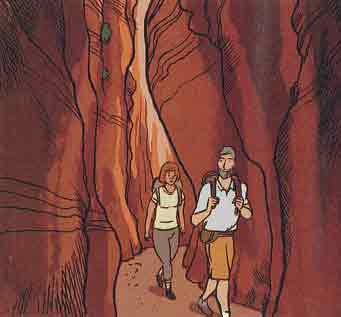
Wilderness Volunteers leader Curt Mobley has a story of a flash flood in Zion when he was hiking with this wife Ann Kruse a few years back that was told in the Sept 2010 issue of Sierra Magazine, and he's given us permission to share his story here (click on the picture to see the full image):