Wilderness Volunteers has been selected as the Volunteer Group of the Year by Yosemite National Park!
With over 9,500 volunteers donating their time and energy in Yosemite this year, it is a great honor to be chosen as the best of the year. We're grateful for the hard work of all of our volunteer participants and especially the project's leaders, Dean and Laurie Twehues. Victoria Hartman, Yosemite's Wilderness Restoration Coordinator, recognizes the group by saying, "Your work is critical to the park’s ability to protect and preserve our rich natural and cultural heritage while providing meaningful and enjoyable experiences for our visitors." All participants will be receiving a thank you gift from the Park as part of the award.
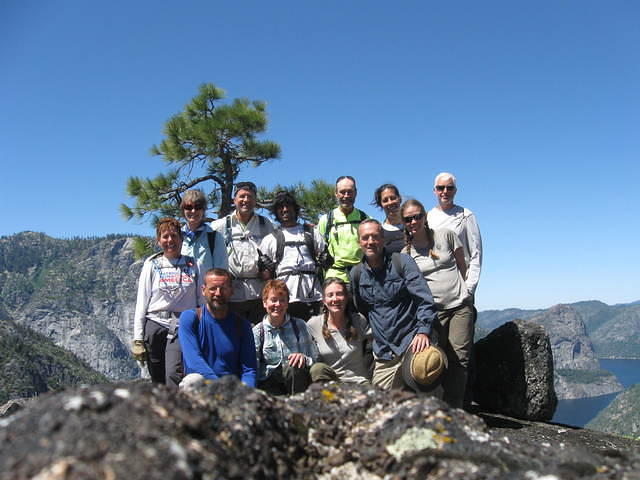
The award-winning WV Yosemite volunteers, June 2013. Photo by Dean Twehues
We just completed the 6th project in the Rancheria Falls area, in the Hetch Hetchy section of the Park. Our work includes removing and ecologically restoring inappropriate campsites, as well as removing non-native invasive species such as salsify, mullein and bull thistle from the Tiltill meadow, a remote high sierra valley with an abundance of wetlands and wildlife. The project requires volunteers to backpack in approximately 6.5 miles to base camp and an additional daily 6 mile roundtrip hike to get to the work site.Sadly, the Hetch Hetchy area is still being impacted by the massive Rim Fire, so we're sure our volunteer stewardship work will be greatly needed in the coming years.
Photo of Hetch Hetchy taken on the WV service project in Yosemite, June 2013 by Lawrence Herko
Dave Pacheco and Paul Goldberg of the WV staff will be on hand in Yosemite to accept the award. The award ceremony will be held on National Public Lands Day - Saturday, September 28th at 4pm in front of the Valley Visitor Center, and will be followed by a raffle and live music as part of the Park's 5-day Yosemite Facelift event. You are welcome to come celebrate with us! The 10th annual Yosemite Facelift is an effort to help clean-up the Park at the end of the busy summer season and runs from September 24 - 29.
Volunteers working in Yosemite, June 2013. Photo by George Ralston
This past week, I co-led a group of intrepid Wilderness Volunteers into the rugged Sawtooth Wilderness to help the agency managing the Sawtooth National Recreation Area with some much-needed trail maintenance. We're proud to say this was WV's 15th project giving something back in the Sawtooths since 1999!
Under the long-time supervision of Liese Dean, Wilderness Program Coordinator, and Deb Peters, Assistant Trails Supervisor and expert packer, we backpacked in five miles to a campsite in the Stanley Creek area of the wilderness and immediately got familiar with our home for the week. Our first impressions were how incredibly clean the water flowed through this magnificent granite-based, Lodgepole pine forest -- some of the clearest water we had ever seen. And we couldn't help but be starkly reminded that the entire location, camp and work sites, were in a burned area from a 2007 fire.
For the next five days we made daily forays of up to eight miles round trip performing an assortment of
trail tasks. Volunteers took turns sawing out 55 downed trees across trails with a six-foot cross-cut saw, we lopped and brushed back overgrown vegetation from 5 miles of trail, and mostly we cleaned out debris and rocks from 244 water bars over that same distance. The water bar work was particularly important because of the unusual level of erosion from the past fire, and they are necessary to divert the water from gouging through trails.
Over the course of the week, we were thrilled with late night visits through camp by Mule deer and elk, and on the smaller scale we were entertained by pika, Clark's nutcracker, bluebird, and some very colorful Western tanagers. Thankfully, Thursday's storms that touched off wildfires across Idaho were well away from the immediate area, but they did make for some incredible evening red skies. The Sawtooth NRA is a place of many streams, deep glacial lakes, craggy peaks, and it's a place many of us will return to as we constantly explore wild America. If you're looking for a spectacular wilderness adventure, join us next year for another week in the Sawtooths!
We're pretty fortunate at Wilderness Volunteers to work with and interact with an excellent group of dedicated volunteers. We're grateful for all the hard work our participants put in, giving something back in precious wild spaces.
One such volunteer that we adore is Katy Giorgio. A longtime participant and WV leader since 2011, Katy takes amazing photos, gets a ton of work done and always is a joy to be around. Not only that, she's a great writer and has a blog! Her latest post is all about the weeklong service project on Admiralty Island in Alaska's Tongass National Forest. Check it out: Katy Goes North.
And you can see more of Katy's photos (and more) in our photo gallery as well.
This week's project spotlight narrows in on a section of the Great Divide in the Weminuche Wilderness of Southwestern Colorado and the epic 3,100 mile Continental Divide Trail that takes hikers from Mexico to Canada. Colorado is a state rich with wild lands and the Weminuche is the state's largest with 488,340 acres of protected wilderness. Lying in both the San Juan and Rio Grande National Forests, the Weminuche is high country, averaging over 10,000' in elevation, with several peaks topping 14,000' and many more over 13,000'. The area has abundant wildlife and gorgeous alpine forests and meadows. The Weminuche is home to the headwaters of dozens of streams and rivers, including the critical Rio Grande and San Juan rivers.
Our project will focus on a section of the Continental Divide Trail north of Wolf Creek Pass in the San Juan Mountains. We will work to ensure the trail is passable with general trail maintenance and proper erosion controls. Our base camp will be at 11,400' after a several mile backpack, affording a great launching point for the work as well as free time adventures.WV project leader Jeff Moorehead had the following to say about the project:
Being born and raised in Durango, I initially cut my teeth backpacking in the rugged Weminuche. I first entered it at the age of 13 and I have returned many, many times on various backpacking ventures since. I have not lost my love for this area and as I grow older, it is more important than ever to get back at least once a year. In addition to the normal rationale one might have for being in a wilderness area, the notable feature of the Weminuche is its expansiveness. One truly feels embedded in the wilds of the Rockies while traveling through this region. You don't have to use your imagination to believe you are really "away from it all".
I love WV trips because everyone attending shares a love for wild places and hard work. Hard work in a wild place brings out the best in a personality and so a WV trip can be a very human experience as well. I endeavor to keep everyone well-fed with good tasting dishes and that is one luxury afforded by the pack train support. Many of my dishes were trail tested on the Pacific Crest Trail which I hiked in 2006. After dinner, I like to discuss hot-bed environmental issues or anything really. In general, I love science discussions. I am an evolutionary biologist that especially loves the world of insects-- specifically grasshoppers and other assorted acridids. People attending the Weminuche trip can expect to hear about the prolific endemic speciation of the alpine Melanoplinae grasshoppers. I'm not sure I buy the current explanation. If that doesn't get people excited, I've been known to sneak up my Martin backpacking guitar and entertain them with songs that are usually set at much lower elevations.
There are many large hydrological divides in the world (the line that separates neighboring drainage basins). None, however, can match that grandeur and prominence of the Continental Divide of the Americas or simply the Great Divide. Determining whether water flows into the Atlantic of Pacific Ocean, the Great Divide stretches from northern Alaska down to southern Patagonia, mostly following the highest peaks of the impressive ranges of the Rockies and the Andes.
Escalante River, Grand Staircase Escalante Nat'l Monument (2006)
If there is one issue all Wilderness Volunteers leaders should concern themselves with when leading a trip, it is how members of the group interact with each other or, put another way, group dynamics. No other issue is of such singular importance when leading WV projects because the effectiveness of a group is directly affected by the way the members of the group respond to each other and to the leader. If my experiences are any indication of group dynamics, I would say that most groups get along well, the participants enjoy each other's company, and most groups work effectively together to complete the task at hand.
But what makes for good group dynamics? A good portion of the answer is in the fact that WV groups are self-selecting. People are coming together for a common purpose of working in the wilderness on something they feel is worthwhile, so WV participants are likely to be similar in a variety of key components. On backpacking trips, that notion is multiplied because people who backpack are an even more exclusive group and thus even more likely to be of a similar mind-set. Anyone willing to put a heavy pack on her/his back and hike several miles (usually uphill) to do something such as heavy trail maintenance is likely to have much in common with his or her fellow participants. The commonality of purpose and the common experience of backpacking unite people and make them more likely to bond.
Of course, luck plays a role in the cohesion of a group. Other factors involved center on the intensity of the backpacking experience. The difficulty factor, living close together for a week in the backcountry and depending on each other, working side by side each day, eating together, talking about the day’s experiences, sharing ideas, solving problems, and doing all those other things a team must do add to the intensity of the experience and help unite the group in positive ways.
What about car camping? How does the model above work in car camping situations where participants are camped near their cars and often near attractions that participants can easily drive to at the end of a work day? My experience has been that it is more difficult to establish the closeness engendered by backcountry projects even though car camping projects involve many of the same experiences. That is not to say that car camping precludes groups from becoming cohesive or bonding in similar ways. However, I do think there is a difference in the way that different types of projects affect the group and the group dynamics.
What is your experience with group interaction in leading trips? Do you have special techniques for getting groups to bond, to become cohesive units, or do you simply let things develop naturally? What do you do, if anything, when the dynamics of the group are developing in negative ways? What happens when one participant’s negativity affects others? What are your thoughts on group dynamics? Let me hear from you; I’m curious.
The recipe below can be used on either backpacking or car camping projects.
Turkish Rice
Olive oil 4 cups rice + 6 cups water (add water as needed during cooking to keep from sticking) 1 large onion 5 garlic cloves, chopped and divided 1 pkg diced Pomi tomatoes 4 cups vegetable broth (use 2 veggie cubes) 1 teaspoon ground cumin ¼ teaspoon red pepper 1 15 oz. can Garbanzo beans, drained and rinsed 1 bunch Italian parsley
Heat oil in large pan. Add onion and cook until tender. Add garlic, tomatoes, salt and pepper. Cook for about ten minutes. Add rice, broth, and simmer (covered) for about 20 minutes. Add garbanzo beans, cumin, and red pepper, blend in to rice mixture and cook for about 5 minutes longer. Add parsley.
Veteran volunteer and outgoing WV Board President Bill Sheppard has led his fair share of trips over the past 10 years. 2011 will be no different, as he'll lead volunteers into California's Desolation Wilderness, New Mexico's Gila National Forest, and Nevada's Great Basin National Park later this year. And while spring and summertime seem a long way off, wintertime is planning time for Bill. Here's what he has to say:
"An annual ritual is underway - and I don't mean the migration of Minnesota "snow birds" to southern Arizona. I'm talking about something quite different, which anyone who has led a group of Wilderness Volunteers into the backcountry can appreciate: trip planning. Every new trip is an adventure, and planning the trip is one of my favorite parts.
The overall structure of the project is set up by Dave Pacheco, WV's Program Manager, who works with an agency contact at each trip destination. Dave gives us leaders "the big picture." What are the dates and the location of the trip? What work will we do and where? Which goverment agency - the Park Service, Forest Service, BLM - manages the area? Will pack support be provided? Who led the project last year?
Now the fun begins for us leaders. Out come the maps, calipers to measure distances, a magnifying glass to read those tiny contour lines. How long is the hike from the trailhead to camp? How far is the work site from camp? What are the elevation gains and losses? How far to the nearest water source? What are we going to eat?
Phone calls and e-mails are exchanged between co-leaders. Who will cook? Who will be the agency contact? Who will write the publicity blurb? Who will contact the volunteers?
We must get commitments from the agency. They must provide plenty of tools, and the tools must be in good condition. We like to have at least one agency person with us to supervise the work project. We rely on the agency staff to answer many questions about the area. Where can we rendezvous on the night before the hike to base camp? What kind of weather should we expect? What interesting places and activities do they recommend for our free day? What kind of animals might we see (and which ones might want our food)?
An important part of trip planning is visualization. In your mind's eye, place yourself at the trailhead, at the base camp, at the work site. What does it look like? How's the weather? How are "the troops" holding up? Our crystal ball is pretty cloudy at this early stage, but it gets clearer as we learn more about the area, the project, and the volunteers. As we get more information, we refine the trip plan and our expectations.
Ultimately, we must remember that our volunteers are taking a week of precious vacation time to "give something back" in America's wild lands - a week which could otherwise be spent lounging on the beach, relaxing at home, or sightseeing among the comforts of civilization. Above all else, we as leaders want to ensure that everyone's experience in the backcountry is safe, meaningful, and fun. And the time to start planning for that is now."
The 2011 Wilderness Volunteer service projects are on the website - all 55 of them!
Spread across 21 states - including Alaska, Hawaii, and a handful of states east of the Mississippi - projects range from trail maintenance and trail building to invasive species removal, campsite restoration, revegetation and more. Regardless of your age and experience, there's a project for everyone - including two canoe trips. Not interested in "roughin' it" in the backcountry, or looking for a less strenuous adventure? Try a front-country car camping trip. Check out the schedule and reserve your place now.
As always, these trips would not be possible without our volunteer leaders, who each year generously donate their time and energy to coordinate trip logistics, prepare menus and meals, and lead groups of eager volunteers into the backcountry. If you're interested in joining this outstanding bunch, consider signing up for the 2011 Wilderness Volunteers Leader Training Trip in the Santa Fe National Forest's Pecos Wilderness.
Lastly, as we enter the holiday season, consider giving the gift of adventure: a Wilderness Volunteers gift certificate. For just $299, you can provide friends and family with stunning landscapes and starry nights, camaraderie and good cheer, and the satisfaction of "giving something back" in one of America's magnificent wild places.
I just returned from the Glen Canyon NRA project where we are removing Russian olive trees from the main corridor of the Escalante River. I've been involved in this project since the mid-1990s, and really enjoy seeing the river cleared of this massively invasive alien. These trees kill the native species and crowd everything along the river's edge, hanging over the river and making travel along the river a painful experience. The trees have long needle-sharp red thorns. Here are two shots of the river, before and after removal of the trees.We reached the 40-mile mark with this trip -- 40-miles of the river corridor have been cleared of the awful trees from the reservoir (Lake Powell) upriver. Follow-up trips every fall keep new starts and any regrowth in check.
On our day off, GLCA Ranger Bill Wolverton takes us on the most incredible dayhikes. I've been in tiny slot canyons, up scary Moki steps, up and down chimneys, learned all about canyoneering, visited remote arches, slithered through mud cracks, rinsed off in refreshing waterfalls, climbed sand dams and entered fern grottos. I can't wait for the next trip here in the spring.
Which brings me to to the title of this post: We are always watching the river while on these projects, and have witnessed several episodes of the water rising quickly and side channels flooding, even when the sky is clear. When it's raining, we are careful to keep all the volunteers on the side of the river where camp is located, but have had a couple of incidents where folks were trapped on the other side for a couple of hours or overnight waiting for the river to drop. We've had no injuries due to our diligence.
Wilderness Volunteers leader Curt Mobley has a story of a flash flood in Zion when he was hiking with this wife Ann Kruse a few years back that was told in the Sept 2010 issue of Sierra Magazine, and he's given us permission to share his story here (click on the picture to see the full image):
Arriving at the trailhead of an entirely new wilderness area is for me a truly invigorating thrill. After nearly eight months of preparation and anticipation (growing much more intense in the final two weeks), the moment has finally arrived. My co-leader Bill and I are leading a one-week service project to clean out existing water bars along the popular Navajo Lake Trail and install new water bars as needed. This work is recommended by our partners in the San Juan National Forest every two-three years to keep the trail properly maintained and drained .
Normally, the anticipation of a week spent tent camping in a glorious wilderness (under three of Colorado's famous 14,000 foot peaks) would be enough excitement for any outdoor enthusiast. But this trip has an added ingredient making it much more special -- this is Wilderness Volunteers' annual Leader Training Trip, where we train a new crop of trip leaders to join our corps of nearly 100 leader volunteers on service projects in years to come.
I arrive in Colorado with Maidie from Portland, OR and we load our backpacks and make the short two-mile hike to our selected camp, within ear-shot of a series of waterfalls on the West Fork of the Dolores River. Five intrepid trainees have chosen this week to learn a variety of outdoor leadership skills: organizing and purchasing food for as many as twelve volunteers, and packing it in panniers strapped to pack horses; preparing and cooking food for groups; keeping a sanitary and safe kitchen and properly hanging food to protect it from animals; teaching Leave-No-Trace principles; practicing strong communications with public land agency personnel; and, ultimately, being an effective backcountry leader. Wilderness Volunteer leaders are required to be trained in Wilderness First Aid and enjoy a series of benefits in return for their time spent planning and leading in the field. Throughout our week on the Navajo Lake Trail we deal with intermittent rain, identify problem areas on the trail and fix them, take a day off to hike through an 11,500' pass, take many, many photographs, learn to be good leaders, and, perhaps most significantly, we make new friends and acquaintances along the way.
We're always identifying and recruiting new leaders at Wilderness Volunteers, and we're beginning the process of planning for next year's annual Leader Training trip. If you're an experienced outdoor enthusiast looking for new and rewarding challenges, contact Dave at dave@wildernessvolunteers.org or 801-467-4305.
Our Mission is stewardship of America's wild lands through organizing and promoting volunteer service in cooperation with public land agencies including the National Park Service, the Forest Service, the Bureau of Land Management and the US Fish and Wildlife Service.
Wilderness Volunteers is proud to be supported by a Matching Grant from the National Forest Foundation. Founded by Congress in 1991, The National Forest Foundation works to conserve, restore and enhance America's 193-million-acre National Forest System. Through community-based strategies and public partnerships, the NFF helps enhance wildlife habitat, revitalizes wildfire-damaged landscapes, restores watersheds, and improves recreational resources for the benefit of all Americans.