Showing posts with label California. Show all posts

Monday, April 04, 2016

Project Spotlight: Yosemite National Park


Combing the meadows
Yosemite National Park stretches across the western slopes of the Sierra Nevada mountain range, spanning nearly 1,200 square miles. Our nation's third national park, Yosemite is widely known for its magnificent rock formations, grassy meadows, crystal-clear streams, majestic waterfalls, rushing rivers, ancient giant sequoia trees, and abundant wildlife.

Over 90% of the park is designated as wilderness, providing a phenomenal variety of growing conditions and habitat for more than 1,450 native plant species.

Our ninth year service project will take place June 5-11, 2016 in the beautiful Hetch Hetchy section of the park. Carved by glaciers and drained by the Tuolumne river, the Hetch Hetchy Valley lies in the northwestern part of Yosemite National Park and contains some of the tallest waterfalls in North America: Wapama Falls, at 1,700 ft (520 m), and Tueeulala Falls, at 840 ft (260 m).

Western Salsify
Our continuing project in Yosemite is removal of several species of invasive weeds such as wooly mullein, bull thistle and western salsify. These invasive plants have the potential to rapidly displace native plants, alter fire regimes, and/or significantly alter ecosystem structure or function.

Common mullein
Because of the complex ecological relationships among native organisms, impacts to native plant communities can negatively affect associated wildlife throughout Yosemite. Invasive plants are prioritized for control based upon the threat they pose and the park's capabilities for successful control. Find out more about non-native species in Yosemite and what you can do to help here.

Project participants will hike in approximately 6.5 miles around the northern shore of the Hetch Hetchy reservoir to Rancheria Falls and set up a basecamp. The hike in is a scenic treat with a modest elevation gain that includes hiking over a dam, through a short tunnel, across a few foot bridges, under some spectacular waterfalls, and maybe even a mist rainbow or two.

Hiking along the reservoir

Wapama Falls
A refreshing mist rainbow
A visitor in camp
From our basecamp we will hike approximately 3 miles to and from grassy meadows in the area each day to work. We'll also likely conduct a day of campsite restoration in the backpackers camp ground at Rancheria Falls. The Park Service will provide pack support to carry the tools, food and commissary gear to camp.

Weed warriors!
Come spend a week in beautiful Yosemite National Park and give something back to our nation's wild lands with Wilderness Volunteers! You can get more information and register for our Yosemite project here. For information about our other 2016 projects visit our website. See more great photos from previous WV Yosemite service projects over at the WV Photo Gallery.

Hiking to work 

Tuesday, January 19, 2016

Reflections on the Retirement of a Favorite National Forest Partner


Below Wilderness Volunteers leader Kathleen Worley reflects on the retirement of Keith Waterfall, a long serving agency contact in the Inyo National Forest.  While Keith may have moved on, Kathleen is leading another great project in the Inyo NF in 2016, this time at Lake Ediza in the Ansel Adams Wilderness.
A WV crew moving logs in the Inyo National Forest .
 Keith Waterfall was the ranger in charge of the first Wilderness Volunteers trip I ever led, along with Bill Olmsted, to the Hilton Lakes in the Eastern Sierra.  He partnered with WV to set up projects in the Little Lakes Valley, at Lamark Lakes, Upper Pine Lake and Honeymoon Lake, Gem Lakes, various places above Lake Sabrina, and up Big Pine Creek in the Seven Lakes Basin below the Palisades Glacier. On that first trip he drove up from his office in Bishop to meet us at the trailhead and hike in with us to show us the project.  He arranged for packers to take in our supplies, with all our food sealed in big bear barrels that looked like oil drums (not the sleek sliver bear boxes we use now). 

Building the causeway
Our task was to build a long causeway through a meadow being trampled by packhorses on their way to Davis Lake.  A great two-man trail crew, John and Eric, supervised our work.  We hauled logs to mark the sides of the causeway, stripped off the bark, gathered rocks, laid them inside the log rails and crushed them with rock hammers, large and small.  We had a great crew. Carol got up early and made coffee every morning.  Joel had every gadget known to mankind, so we connected via radio during the free day, one group atop a mountain and the other at the edge of a waterfall.  Amy swam out to the island on Davis Lake at lunch while the rest of us watched the week-long progress of a fire high up in a granite bowl above us.  John came to my rescue when bears returned to camp in the middle of the night after breaking into one of the food barrels earlier in the day.  They’d eaten or carried off most of that night’s dinner, but we managed to improvise something; for the rest of the week people returned from trips into the woods carrying tooth-dented cans of tuna.

Not all trips Keith set up were quite as memorable, but there was always something strange and wonderful.  He chose campsites with amazing views and a good spot for a kitchen.  He found us places to camp the night before each trip and chose great packers to take us in and back out again.
Volunteer Michelle Collins "holding up a rock" on the 2013 Bishop Pass project
Some projects were more fun than others but all felt worth doing.  We had a great time destroying all trace of the former trail over Bishop Pass.  Though a new trail had been constructed, people coming down the pass could see the old one and were tempted to take it, since it looked shorter and less steep, but it passed under an active glacial moraine that could at any moment roll giant rocks onto unsuspecting hikers.  We got to roll many a rock ourselves, obliterating all evidence of the former pathway.  We also attempted to obliterate all non-natural traces of a former private lodge in the Seven Lakes Basin.  We filled and carried bags of cement from the foundation down the trail to a point above one of the lakes where we could dump the cement into the water. At one point, a woman in a pink inflatable boat rowed across the lake to find out what was happening, threatening to report us to the forest service.  She didn’t know what to make of the fact that the people who were doing the dumping were in fact forest service employees.  We cleaned campsites, got rid of fire rings, built a new trail at Gem Lakes, built checks and steps above Sailor Lake on the way to Hungry Packer and Midnight. We got to visit Heidi’s house, the remains of what had been built for the High Sierra filming of Heidi. This past summer, I joined Misha Kokotovic for the leader training trip at Honeymoon Lake and walked on the stone pathway above the lake created by the WV crew Ron Harton and I had led there many years before.  
Leader trainees Bobbie Morrison and Dave Marancik on the 13 year old stone pathway built by an earlier WV crew.

Tools packed by Keith
Keith always sent us out with great trail crews, though the crews had fewer members as forest service budgets diminished.  He did his best to find worthwhile projects we could accomplish successfully, knowing that WV crews are capable of more than might be expected of others.  We worked with Student Conservation Association interns, with Friends of the Inyo, with volunteer camp hosts, with back- country rangers, with trail crews and on our own.  Now that Keith has retired, we don’t know what will happen exactly.  The Forest Service has decided that the Inyo National Forest can cutback on trail crews and back-country rangers, so they will need volunteers more than ever, and yet there may be less staff to identify and/or supervise projects. (Editor's note: The 2016 Inyo project at Lake Ediza is being planned with the Mammoth Lakes office instead of Bishop office). I will miss the yearly conversations I had with Keith about where we might go, what we might do, why some trips filled and others didn’t and what we might do about that.  I will miss meeting him at the office in Bishop where I would transfer all the food from bags and coolers into the sleek silver bear boxes that packers would carry up for us and that no bears ever managed to open.

On behalf of WV, I extend many, many thanks to Keith Waterfall for being one of our longest-term partners. His last name seemed so perfect for a man who was so well fitted for his position that we sometimes wondered whether it was a name he had acquired rather than one he was born with. In any case, it suited him as perfectly as he suited his job. May it continue to connect him with wild places during his retirement. Keep in touch, Keith. We’ll miss you.  

Kathleen Worley grew up in Reno, Nevada, which perhaps explains her love of the high desert as well as the granite spires and crystal clear lakes of the Eastern Sierra Nevada. She has led more than 30 projects with Wilderness Volunteers in Nevada, Utah, Idaho, Oregon, California, and Hawaii. She recently retired from teaching theatre at Reed College in Portland, OR.

Monday, November 16, 2015

A look into the Joshua Tree National Park service project

Wilderness Volunteers hosted our first service project with Joshua Tree National Park last month and we were able to help their trail crew finish a needed project refinishing the cholla cactus garden trail  and making it more accessible to visitors.

Volunteer Tom Coroneos documented his experience on his 18th WV project and created this lovely video. Take a look and hopefully you can join us next year when WV returns to Joshua Tree NP in 2016.


Joshua Tree Wilderness Volunteers 2015 from Tom Coroneos on Vimeo.

The full 2016 schedule will be released in early December. Spring projects are available right now on the WV website.

Tuesday, April 28, 2015

Project Videos: Pinnacles NP, Mojave NP, Pt. Reyes NS


Veteran Wilderness Volunteer Tom Coroneos has done more than 20 projects giving back all over the country! And beyond being an excellent volunteer, he's terrific at making movies, having put together many great videos, including several about his recent WV projects! Take a gander at Tom's excellent work below:

Pinnacles National Park 2015

Mojave National Preserve 2015

Pt. Reyes National Seashore 2014

Mojave National Preserve 2014

And Tom is currently out in the field at the Pt. Reyes National Seashore project, so we can likely count on another video coming our way soon. Thanks Tom!


Tuesday, April 29, 2014

Cool Adventures Towering Above Hot Moab

Join Wilderness Volunteers on our second annual project in the La Sal Mountains of the Manti-La Sal National Forest, July 27 - August 2, 2014. The La Sal Mountains are the second highest range in Utah and offer miles of trails, great wildlife viewing, abundant fields of wildflowers, comfortable temperatures and astounding views of the slick-rock deserts below.

Photo from the La Sal Mountains out to the Red Rock Desert, Taken July 2013 by P. Goldberg
Our service project for 2014 is conducting maintenance of heavily used trails in the Geyser Pass area of the central La Sal range. The Manti-La Sal National Forest struggles to keep a myriad of user types all satisfied and trails delineated for specific purposes. We'll improve drainage and increase the stability of the trail tread.  We'll set up a car camp around 10,000' elevation for the week, and day hike to the work sites with tools.  Nearby peaks top out in the range of 12,000', so come prepared for some free day hiking with unbelievable views...and don't forget your camera!

La Sal Mountains loom behind Fisher Towers - July 2013, photo by P. Goldberg
Read more about the area in our interview with Brian Murdock - Recreation, Wilderness & Trails Manager for the Monticello/Moab ranger district of the Manti-La Sal National Forest. 


Wednesday, November 27, 2013

Photo from the Field: Pinnacles National Park by Ulrich Boegli

To celebrate the upcoming holiday, this week's photo from the field is of wild turkeys found at Pinnacles National Park. This photo was taken by Ulrich Boegli when visiting the Park a few months in advance of the Wilderness Volunteers' service project he would join in spring 2013. These native turkeys are regularly seen and heard from the Park's campground.

While WV's 2014 service project in Pinnacles is full, opportunities remain to sign up for spring service projects in other fantastic wilderness areas around the country.


From all of us at Wilderness Volunteers, thanks for all of your efforts giving something back this year! Have a wonderful Thanksgiving!

Monday, November 11, 2013

Photo from the Field: King Range NCA by Eric Mak

Sharing photos from the field has been a regular feature from the WV facebook page and we'll now be sharing on the blog as well!  If you have a favorite photo that you'd like us to feature, please let us know by dropping a note to info@wildernessvolunteers.org.

This week's photo from the field is from WV's first service project on Northern California's coastal King Range Conservation Area, taken by Eric Mak.  The project, which ran from April 20-27, featured coastal hiking, trail maintenance and a day of beach cleanup as pictured below.

WV will return to King Range this spring and you can sign up for that project and more on the project page.


You can find more of Eric's terrific photographs and photos from many of WV's service project in our photo gallery.


Thursday, September 12, 2013

WV Honored as Yosemite Volunteer Group of the Year


Wilderness Volunteers has been selected as the Volunteer Group of the Year by Yosemite National Park!

With over 9,500 volunteers donating their time and energy in Yosemite this year, it is a great honor to be chosen as the best of the year. We're grateful for the hard work of all of our volunteer participants and especially the project's leaders, Dean and Laurie Twehues. Victoria Hartman, Yosemite's Wilderness Restoration Coordinator, recognizes the group by saying, "Your work is critical to the park’s ability to protect and preserve our rich natural and cultural heritage while providing meaningful and enjoyable experiences for our visitors." All participants will be receiving a thank you gift from the Park as part of the award.

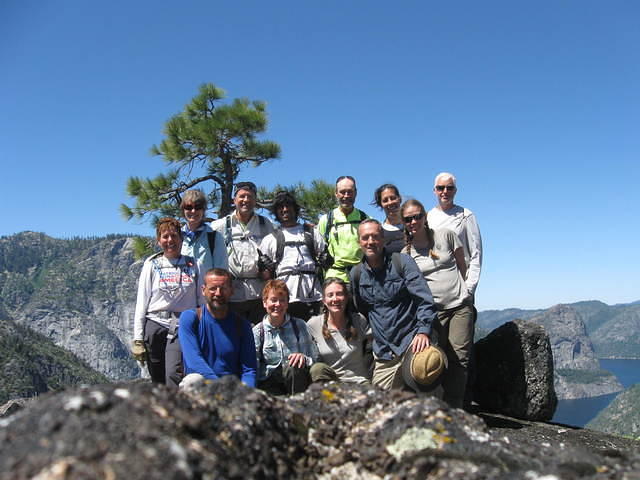
The award-winning WV Yosemite volunteers, June 2013. Photo by Dean Twehues
We just completed the 6th project in the Rancheria Falls area, in the Hetch Hetchy section of the Park. Our work includes removing and ecologically restoring inappropriate campsites, as well as removing non-native invasive species such as salsify, mullein and bull thistle from the Tiltill meadow, a remote high sierra valley with an abundance of wetlands and wildlife. The project requires volunteers to backpack in approximately 6.5 miles to base camp and an additional daily 6 mile roundtrip hike to get to the work site. Sadly, the Hetch Hetchy area is still being impacted by the massive Rim Fire, so we're sure our volunteer stewardship work will be greatly needed in the coming years.

Photo of Hetch Hetchy taken on the WV service project in Yosemite, June 2013 by Lawrence Herko

Dave Pacheco and Paul Goldberg of the WV staff will be on hand in Yosemite to accept the award. The award ceremony will be held on National Public Lands Day - Saturday, September 28th at 4pm in front of the Valley Visitor Center, and will be followed by a raffle and live music as part of the Park's 5-day Yosemite Facelift event. You are welcome to come celebrate with us! The 10th annual Yosemite Facelift is an effort to help clean-up the Park at the end of the busy summer season and runs from September 24 - 29.

Volunteers working in Yosemite, June 2013. Photo by George Ralston

See more photos from this project and more via the WV photo gallery.

Thursday, June 06, 2013

WV Receives Presidential Volunteer Service Award


We were happy to receive this award and accompanying letter from President Obama in the mail this week.  This recognition was prompted by our agency partners at the Sierra National Forest, due to our continuing service project in the John Muir Wilderness.  Space is still available to join this project in California's Sierra National Forest, applauded by the White House, which runs August 11-17.

Sierra NF's Partnership Coordinator, Chor Yang, thanked WV for our "untiring commitment and unyielding dedication." We are grateful to all WV trip participants for joining in the effort to give something back as we celebrate and sustainably steward our country's wild lands.


Tuesday, May 14, 2013

WV Visits King Range NCA on California's Lost Coast

California's Lost Coast, photo courtesy of Eric Mak
In late April, a Wilderness Volunteers group trekked on an 8 mile backpack to a beachside campsite deep into the rugged Lost Coast of Northern California.  The Lost Coast is the longest stretch of undeveloped coastline in California. 68,000 acres are managed as the King Range Conservation Area by the Bureau of Land Management. The terrain is extremely rugged and the area experiences relatively frequent earthquakes due to the nearby Mendocino Triple Junction - the meeting of three tectonic plates just offshore.  Home to lush forests of Douglas-fir, Coastal Redwoods and Tanoaks, the area supports abundant wildlife including endangered coho and chinook salmon, steelhead trout and spotted owls.
Not a bad place for a hike, photo courtesy of Eric Mak

This was WV's inaugural service project with the King Range National Conservation Area. Participants worked on trail maintenance, including building new sections of trail and water crossings, as well as removing beach debris.

WV participants repair a major section of trail and build a water crossing, photo by Eric Mak
By all accounts the trip was successful! We received these kind words last week from Gary Pritchard-Peterson, the manager at King Range NCA.
We're very grateful for all the participants' hard work and are really looking forward to returning to the area next year!


Monday, May 06, 2013

My First WV Project

While I’ve come to get the know Wilderness Volunteers very well over the last half year as the organization’s first Development Coordinator, it wasn’t until the recent service project in America's newest national park, Pinnacles, that I got to experience WV in the field. It was a truly wonderful experience getting out into the wild to give something back as well as meeting a terrific group of dedicated volunteers and park personnel.

The WV group at Machete Ridge in Pinnacles NP
We arrived to the Pinnacles campground on the east side of Pinnacles on a warm Sunday afternoon after a lovely drive down highway 25, known as Airline Highway supposedly because pilots used the highway as a marker on the route from LA to San Francisco. The highway has beautiful rolling hills as it parallels the San Andreas Fault, which figures into how Pinnacles came to be. The exposed rocks of Pinnacles' peaks differ from these surrounding foothills, as it is part of the remains of a massive ancient volcano that was active 23 million years ago. As part of the Pacific Ring of Fire, the volcano was 15 miles long and nearly 8,000 feet high.  Surprisingly, the volcano was located nearly 200 miles to the southeast, just north of where LA is today. Due to the earth's tectonic plates colliding and shifting, the volcano was split and two-thirds of the remains have been pushed north to where it lies now.  As the plates moved, the mass sank and erosion has carved the impressive spires that are the Park's most recognizable feature. Surprisingly, the rocks continue to move towards San Francisco at the rate of a quarter of an inch per year.
Hard to believe these rocks made a 200 mile journey to get here.
After we all arrived and set up camp, the group began to get to know each other over our first fabulous meal prepared by Carleton Sheppard. Wonderful meals would become a regular occurrence during our week at Pinnacles thanks to Carleton.  The other half of our leader team, Bill Sheppard, then gave us a brief intro on what to expect for our first workday the following morning, when we would meet with the NPS staff.
On the hunt for thistle, Photo by Ulrich Boegli

After a hearty breakfast, we were introduced to the park by NPS staff Brent, Lucy and Esperanza, who gave a great overview of the Park's features, history, conservation management goals and potential hazards to be aware of during our time in the backcountry. We were then given leather work gloves, counters, hiking poles and snake chaps as we set out to begin our week hunting for invasive plants throughout the park. Lucy and Esperanza would be our guides for the week and we began by searching from the Bear Gulch area back to campground for invasive Italian Thistle.  We scoured hillsides and walked along a wide seasonal creek bed filled with native poppies. After lunch we spread out to scour through a section of forest until one of our volunteers, John, found the mother load of thistle. We all joined together in an approx. 40' x 40' area to pull thousands of this invasive weed that has been choking out native species.

Tuesday was our free day, since there was a meeting that required attention from NPS staff and we split into groups to climb into the heart of the park via the High Peaks Trail, sadly leaving behind one of our compatriots at camp who was feeling under the weather. Despite leaving at different times and taking slightly different routes, our group met up at the Scouts Peak lookout that offered views to the west of the Salinas Valley and the Santa Lucia Mountains that lie run along the coast. We then climbed the steep and narrow section of the trail, which was exhilarating!  Yet another fabulous lunch was followed by nice views of the Balconies section of the park and then venturing down Condor Gulch trail, which gave terrific views of the rocky crags and spires. Tuesday also was the first time for confirmed sightings of one of the park's other claims to fame - home to the endangered California Condor.


Wednesday morning was the coldest of the week, reaching just above freezing.  While the cool nights
There's invasive mustard under there.
generally offered a nice respite to the hot and dry 90 degree days, this was a very chilly morning. We warmed ourselves by a nice morning fire before taking off on one of the longer hikes of our time in the park. Departing from the Old Pinnacles trailhead, we walked north of the high peaks we had climbed the day before, along the relatively level Chalone Creek - named after the indigenous people who lived in the area. All week long we saw many beautiful birds and butterflies, and this day was no exception. After reaching the entrance for the West side of the park, we went off-trail to attack the other invasive plant we would hunt during our time at Pinnacles - invasive mustard.  We found many mustard plants, some right as they were flowering, preventing the plants from reaching the bolting stage. All the while, we had terrific views of Machete Ridge. After successfully removing several thousand mustard plants, we trekked back to the eastside of the park, passing through Balconies Cave. The caves in Pinnacles are another fun feature of the Park.  They are above-ground Talus caves, formed by falling boulders and rocks trapped in steep canyons.  The caves are partially closed to protect the bat populations that make their home there and are fully closed to the public during breeding season.

Thursday was a fascinating day as we were introduced to Alacia Welch, one of the Park's Condor Biologists. Alacia led us to areas of the Park normally closed to the public.  We ventured up a steep road to a ridge where we would continue our hunt for invasive plants. Working along steep terrain, we were treated to views that few visitors to Pinnacles see.  We also watched a young condor perch in a tree nearby the NPS facility and then watched as it took flight over our heads. Their wingspan is seriously impressive. We asked Alacia every question we could think of, and weren't able to stump her. We toured the condor facility and saw how they trap and release birds, and monitor the birds through one-way mirrors.
Alacia answered every question we could think of.
The California Condor was very nearly extinct due to poaching, lead poisoning and habitat destruction - with only a population of 22 in the wild in the 80s. A controversial captive breeding program began in 1987 by the government and continues to this day. Pinnacles is an important site for monitoring the health of the population, with other important sites in Southern California, Baja and Arizona.  Those original 22 birds were given numbers #1-22 and tagged with monitors. The population has now reached more than 400, with more than 200 living in the wild.  

We also assisted Alacia by moving brush to cover exposed water lines that had recently been installed by the facility. We then continued to hunt for invasive plants and took an adventurous off-trail route down the mountain and back to the campsite.
Our group covered the line behind this way neat condor facility
Friday was our last work day, but it proved to have some of the most impressive scenery of our time at Pinnacles.  We began by traveling through the Bear Gulch caves and reaching the bear Gulch Reservoir - a man-made reservoir to be used in case of fire protection. We then ventured off-trail into backcountry canyons, searching for more invasive plants, finding both thistle and mustard, as well as hundreds of butterflies, birds and a snake or two.


My first WV service project was an absolute blast. By my estimates we pulled more than 10,000 invasive plants, covered over 30 miles of hiking and saw a terrific array of flora and fauna. My biggest takeaway, however, was how wonderful all the participants were! Our leaders, Bill and Carleton, were fantastic and kept us safe and well fed. All the volunteers were lovely folks, had a wonderful attitude and really embodied the spirit of giving something back.  I can't wait for my next WV trip!