Showing posts with label Gila. Show all posts

Tuesday, April 07, 2015

Photos From the Field

Our 2014 photo contest had many wonderful submissions, such as the following great shots of the moon.

WV participant David Peters on two of his photos he took on the Continental Divide Trail building project in New Mexico's Gila National Forest:

I love taking photos of the moon, playing with exposures and focal distances and compositions. The photos are most special when I captured the moon juxtaposed against something distinctive in the place I’m visiting. On the Continental Divide trip, I had the advantage of a full moon and a clear sky at 8,600 feet above sea level. When the moon rose on the evening of the full moon, I thought I had missed the best opportunity because the divide ridge behind our camp obscured the moon until it was high in the sky. But I wandered around my tent site until I was able to place some ponderosa branches in front of the lunar image.

Then the next morning, as the moon was setting in the west, the rising sun illuminated the few clouds on the horizon, turning them a New Mexico pink and blue as ponderosa pines framed the image.

See more of these great photographer's works, as well as many more photos from our 2014 season at the gallery. And stay tuned for more information on the 2015 WV Photo Contest!


Thursday, November 13, 2014

Continental Divide Trail


Wilderness Volunteers recently did a week of work on the Continental Divide Trail (CDT) near Apache Creek, NM, in cooperation with the Glenwood Ranger District of the Gila National Forest. We were building new trail through a section of the forest that is closed to this activity for all but a few months each year due to proximity to Mexican spotted owl habitat. It was hard work but very rewarding to see the new trail come together.

The CDT spans five states and travels 3100 miles along the spine of the country. It is a combination of dedicated trails and backcountry roads and is considered 70% finished. The Gila Forest is building trail to take it off the forest service roads which will improve the experience for hikers using it.

Standing from left: Paul, Cloudwalker, Don, Debbie, Annette,
Josh, Chris. Seated: Paul, Sarah, Liz, Katy, Bill

One evening we were eating dinner when we spied a hiker on the trail, walking south at a high rate of speed. We asked him to join us and didn't have to worry about what to do with leftovers that night. His trail name was Cloudwalker, and the CDT was his third through-hike as he'd already completed the Appalachian (AT) and Pacific Crest( PCT) trails, in fact, he hiked the AT (2,200 miles) just before he started on the CDT!

He was full of enthusiasm, and it was great to meet an actual through-hiker while we were working on the trail. When we went back to work the next day, we could see visions of these robust characters passing through on the trail we were creating.
Before and After -- a trail is born                     photos by Paul Walski
Wilderness Volunteers will offer this trip again in 2015 on June 7 - 13th. Spend a week on the Continental Divide and help us on this legendary trail!

Experience the trail we completed here:


Wednesday, November 20, 2013

Interview with Annette Smits, North Zone Trails Coordinator for the Gila National Forest

We checked in with Annette Smits, the North Zone Trails Coordinator for the Gila National Forest ahead of our returning service project there, June 8 - 14, 2014. We asked Annette about the area, her work and how to help, among a number of other topics.

Tell us about the most unique aspect of the wilderness area that you manage. What draws visitors here?
In my zone (I cover 3 districts of the Gila) we cover 2 wilderness areas-all of the Blue Range and the western half of the Gila Wilderness, as well as General Forest Areas (GFA) and Inventoried Roadless Areas (IRA).

For the Blue Range the most unique feature is likely solitude, I can think of few other areas that give the user a chance to truly get away from it all. We have amazing dark skies, great hunting, and opportunities to catch glimpses of wildlife of all sorts from elk to raccoons or hear wolves howling in the distance.

For the Gila, the biggest draw is that it is one of the original wilderness areas, where Aldo Leopold got some of his inspiration. Where the green fire died in the wolf’s eyes. The western half has extremely rugged terrain that draws people looking for a challenge.

Tell us about the most important types of projects a group of volunteers can do to help in your wild backcountry areas.

Trail work. In my opinion trails bring people into our great public lands and give them the opportunity to experience them and grow to love them. Trail work is hard work in that is very demanding in terms of resources. Trails serve as a means to concentrate use, and reduce impact to natural resources (for example we typically route our trails away from sensitive resources whether cultural or biological). I think if we provide a sound way for people to come out and enjoy our backcountry they will start to love them and want to protect them.

Why do you work with Wilderness Volunteers?

We partner with WV, because we need help. What makes WV such an ideal group to work with is the continuity of leadership, the ease of working with leaders who are already savvy about being out in the woods and leaving no trace, and the general professionalism of Wilderness Volunteers as an organization. 

About the WV service project:

Our projects have been on the Continental Divide Trail (CDT) construction. Currently much of our route of the CDT is on roadways, where non-motorized users are competing for space with trucks and ATVs. For the last few years we have been working on creating a new trail where people can enjoy the panoramic vistas, in the peace and quiet that the Gila is known for. In the still of the forest a user can catch glimpses of herds of elk, bobcats, deer, bears, various birds, coyotes, and other wildlife. It may be a personal bias here, but these things can make for an outstanding trip whether out for the day or on a longer trip. In partnering with WV we are giving more people the chance for these experiences. The way in which WV operates make them an extremely easy group to work with. There is always going to be set up time with any project, but due to good planning and working with the same leadership every time the amount of work that goes into a WV trip is much less than what is generally expected with volunteer groups in general. Working with WV, all that I really need to do is show up with tools, safety equipment, and water the rest of the in and out day-to-day logistical stuff is covered by WV. Any trip that is being coordinated by WV is one that as I can count on as being a productive week as a land manager, and an enjoyable week on a personal level.

How can folks continue to give back to your area when not on a WV project?

Being our eyes and ears out in the field. I cover about 1½  million acres in my zone, so needless to say there are a lot of things that I don’t know about as far as day to day stuff. Though we may or may not be able to deal
with the issue rapidly, the sort of things that are very helpful for us to know about are:
·        Water and spring conditions (or lack thereof)- this is the most common question I get asked, and being in the southwest water is almost always scarce. If at least I could say as an example- as of June 18th there was water in spring x. At least it’s a bit more certain than a guess.
·        Noxious weeds- this is starting to become more of an issue in our areas. If we have the opportunity to find and remove these outcropping while they are still small we have a much better chance of removing them.
·        Trail conditions- not necessarily a single tree down, but if there are excessive numbers of them down, trail has extreme washouts, if the trail is very difficult to find, or anything that looks out of the ordinary out there. 

Wednesday, January 09, 2013

Trip Spotlight: Continental Divide Trail in the Gila National Forest


Photo from WV's CDT Service Project in the Gila NF 2012
Today we turn the spotlight onto WV’s service project along the Continental Divide Trail (CDT) in the Gila National Forest. There are lots of interesting tidbits about the history of the land and the remarkable CDT in addition to the abundant hot springs and diverse wild beauty of the area. Established as a National Forest in 1905, the Gila National Forest offers a vast and remote cross section of natural southwestern splendor, from the dry, flat semi-desert terrain in the lowlands up to rugged, high mountains and canyons. The 6th largest National Forest in the continental US, Gila boasts a broad and robust biodiversity and a unique confluence of ecosystems with riparian systems adjacent to high desert and old growth forest.
Flowering cacti in the Gila National Forest
This land is also the birthplace of America's wilderness-conservation movement, as the Gila Wilderness within the National Forest was established as the very first designated wilderness in the country in 1924. The rewards of wilderness designation can be found throughout the unspoiled land. The Mogollon Mountains top out at 11,000 feet and support rich high spruce, juniper, aspen and fir forests, while down at 4,200 feet octoillo as well as chihuahuan and upper sonoran desert cacti dominate the landscape. Wildlife such as the black bear, mountain lion, elk, deer, antelope, bighorn sheep, and wild turkey roam the area while the bald eagle, peregrine falcon, and the red-tailed hawk are amongst the birds that soar overhead. Many imperiled species reside in the Gila National Forest including the mexican spotted owl, mexican grey wolf, gila chub, southwestern willow flycatcher, loach minnow, spikedance and more.
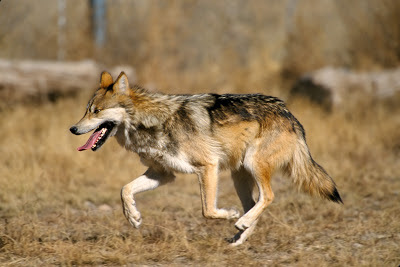
Mexican Grey Wolf, Photo by Jim Clark USFWS
Indigenous populations have a longstanding history with this land. An ancient Puebloan people, the Mogollon, are thought to be the first human settlers in the area. Before or after our service project, you can visit the ancient past with a trip to the Gila Cliff Dwelling National Monument, located within the National Forest, to see the remarkable structures within five sandstone caves. It is not known why the dwellings were abandoned 700 years ago, although Hopi oral tradition does say migrations occurred due to cycles of beliefs and in response to changing climate. 
Gila Cliff Dwelling photo by NPS Photo, Barry Nielsen
Our service project is one of two we have that focuses on the construction of a segment of the epic Continental Divide Trail (CDT). Stretching from Mexico into Canada, the trail travels 3,100 miles following the Continental Divide along the Rocky Mountains, traversing Montana, Idaho, Wyoming, Colorado and New Mexico. Established in 1978, the CDT offers opportunity for adventure with one of the most significant features on the continent. The trail is about 70% complete and includes dedicated trail and small roads. We'll work on the trail while based in a spike camp in the nearby forest, hiking to work everyday where we'll construct tread, brush the trail corridor, and install erosion controls. This trip is suitable for seasoned volunteers as well as beginners in good shape who want to learn about camping, trail construction and Leave No Trace. Learn more and sign up for WV’s Continental Divide Trail Project in the Gila National Forest.
Photo taken during WV's Gila NF Service Project 2012