Showing posts with label 2013 trips. Show all posts

Wednesday, January 15, 2014

Interview with Brian Murdock of the Manti-La Sal National Forest

We recently caught up with Brian Murdock, the Recreation, Wilderness & Trails Manager for the Monticello/Moab ranger district of the Manti-La Sal National Forest to talk about our work in the Dark Canyon Wilderness; our next project there is May 11 - 14, 2014.
"The area that I am fortunate to manage is the Dark Canyon Wilderness. I have heard it referred to as the wild heart of the Colorado Plateau and I like that description. I believe one of its most unique qualities is the solitude it offers. As more and more of our wildlands are seeing increasing use, the logistics of getting into the area and the sheer remoteness of the canyon makes use relatively low in the Dark Canyon area. If you want a real wilderness experiences with a good chance of being completely alone and you are prepared, this is the place.
We are always in need of trail work. The wilderness is a dynamic system and keeping trails open and passable is a Herculean task that never ends. Wilderness Volunteers has put a lot of time into helping the US Forest Service remove tamarisk which we finished up in 2013.
Currently the recreation and wilderness staff on our district consists of two full time employees and 5-7 seasonal employees. The reality of our work is that we cannot meet all of the demands we have in managing developed and dispersed recreation, trails (non-motorized and motorized), outfitter and guides, and our winter recreation program on two different mountain ranges (the LA Sals and the Abajo/Elk Ridge) with the staff we have. Volunteers are a necessity if we want to fulfill our management responsibilities and Wilderness Volunteers has been one of our best partners in achieving our wilderness management goals. 
Our most recent projects with Wilderness Volunteers has included two annual trips each year for the past 8 years. In the spring we have conducted tamarisk inventories and removal and in the fall we do cultural inventories of the area. In 2013 we cleared the final tamarisk from the wilderness (that we know about). It was very satisfying to be able to clear all of the springs and wetlands of the invasive trees. I am sure there are still some lurking out there but  Wilderness Volunteers made the Dark Canyon Wilderness a much more natural and wild place with the work they did removing tamarisk. We also conducted a trail project this year in the La Sal mountains with Wilderness Volunteers that was very successful. The enthusiasm of the volunteers is always infectious. I love introducing people to new areas and watching them fall in love with Dark Canyon and the other areas we manage.
You can continue to give back when not on a WV project by educating everyone around you about the importance of public lands and in particular about wilderness. I think a lot of the American public have major misconceptions about wilderness. Having Wilderness Volunteers telling others about their volunteer trips and their accomplishments can go a long way in educating the public about wilderness and its management."


Wednesday, November 27, 2013

Photo from the Field: Pinnacles National Park by Ulrich Boegli

To celebrate the upcoming holiday, this week's photo from the field is of wild turkeys found at Pinnacles National Park. This photo was taken by Ulrich Boegli when visiting the Park a few months in advance of the Wilderness Volunteers' service project he would join in spring 2013. These native turkeys are regularly seen and heard from the Park's campground.

While WV's 2014 service project in Pinnacles is full, opportunities remain to sign up for spring service projects in other fantastic wilderness areas around the country.


From all of us at Wilderness Volunteers, thanks for all of your efforts giving something back this year! Have a wonderful Thanksgiving!

Monday, November 11, 2013

Photo from the Field: King Range NCA by Eric Mak

Sharing photos from the field has been a regular feature from the WV facebook page and we'll now be sharing on the blog as well!  If you have a favorite photo that you'd like us to feature, please let us know by dropping a note to info@wildernessvolunteers.org.

This week's photo from the field is from WV's first service project on Northern California's coastal King Range Conservation Area, taken by Eric Mak.  The project, which ran from April 20-27, featured coastal hiking, trail maintenance and a day of beach cleanup as pictured below.

WV will return to King Range this spring and you can sign up for that project and more on the project page.


You can find more of Eric's terrific photographs and photos from many of WV's service project in our photo gallery.


Wednesday, October 30, 2013

A Transformational Trip To Escalante by Rebecca Glucklich

Yes, I am “that girl” who decided to go to Utah after reading Aron Ralston’s “Between a Rock and a Hard Place” and watching 127 Hours – I was mesmerized by the slot canyons, the vast expanses of empty desert, the hoodoos – it just looked other-worldly. I would occasionally pop online to see if there were any guided trips to Moab or the surrounding areas – I was smart enough to know that I really shouldn’t trek alone since I have quite a fondness for my limbs, but everything was out of my budget or just not at the right time. This past February, I was visiting my parents and going on about Utah when my dad pointed out that I’d been talking about taking a trip out west for years now and I just needed to “make it happen already!” On a whim, I Googled “Utah volunteer trek” and lo and behold, the WV site popped up in my search results. Little did I know that this Google search would change my life.

For the months leading up to my departure date, I got a ton of “You’re going WHERE? To do WHAT?” from friends, co-workers, really anyone who I told I was going to Utah to chop down Russian Olive trees. But I also got a lot of “wow – you’re brave!” I spent my lunch hours searching for gear online and around my office, and thankfully had friends to lend me a sleeping bag and one adventurous sister to lend me a tent. Yes, I was nervous and had no idea what to expect, but just knowing that I’d really wanted something and made it happen gave me the boost I needed to make the solo journey to Escalante.

Upon arriving after a 6 hour car trip with one of my fellow volunteers, I was pleasantly surprised to see that our camp site was complete with bathrooms and showers, a fresh water pump and a glorious, sparkling albeit freezing cold reservoir. Hardly what I’d call “roughing it” but it was a good way to ease back into outdoor life. After all, I hadn’t been on a real camping trip in over a decade. I was immediately welcomed into the group, who were also a bit astonished that I had just hopped on a plane and left Boston for a week in the desert without knowing a soul. These folks would soon become my dear friends and confidants for my week long adventure and I could tell by the first dinner that I was going to have the best week ever. 

The work is hard. Really hard. 6 or so hours a day in the desert heat sawing, loping, hauling and chopping these beasts of trees with thorns so sharp they’ll go right through your shirt (I have a few battle scars to prove it.) But after my first day, I felt more relaxed and at ease than I had been in years and apparently left some of my inner aggressions out by the banks of the Escalante River. I wasn’t thinking about my job or my personal life or Facebook (although, I was a little relieved to have wireless at night to post some stellar pics!). Every day, though the hike to and from the worksite got a little longer, the days seemed to fly by. I spent one whole morning in and by the river working on deconstructing a massive snarl of Russian Olive trees, river debris and probably a few other types of plants and trees. When the Russian Olive was finally cleared out enough for the sawyers to take down, it was the most exhilarating and satisfying feeling in the world. To quote one of my other favorite books, “I swear we were infinite.” (The Perks of Being a Wallflower)


After a week of sawing, chopping, exploring slot canyons, searching for pictograms, staring at the night sky and falling asleep to the LOUDEST frogs ever, it was time to go home. As I made my rounds of hugs and goodbyes to my new friends, including my fearless leaders Dudley and Chris, I couldn’t help but feel a little heaviness in my chest. I grew so close to this group of strangers in such a short amount of time and had a feeling that although we may be scattered around the country, we’d keep in touch and even see each other again on a future WV trip. Even now, as I write this, I must admit, my eyes are tearing up a bit remembering what an incredible time I had. 

Within a week of my return, not only was I offered a new job at a new organization, but many of my friends remarked that I seemed much more relaxed and happy. I came home with such a sense of accomplishment, a feeling that I really can do whatever I set my mind and heart to. I truly felt as if my life had been changed and I have WV to thank for that. I don’t know if any WV trip will top my first one, but I will certainly do my best to try!


***

The 2014 Wilderness Volunteers spring schedule is available now, including service projects in the Grand Staircase-Escalante National Monument and along the Escalante River in the Glen Canyon National Recreation Area. We invite you to join us in giving something back and experience the loudest frogs ever.

Tuesday, October 01, 2013

Government Shutdown Impacts WV


Unfortunately, while the government is shutdown WV will not be able to send out many of the remaining service projects on our 2013 schedule. All of the country's National Parks, National Wildlife Refuges, Bureau of Land Management lands and National Forests are closed for business until Congress passes a Continuing Resolution to fund the government. All "non-essential employees" of the federal government have been furloughed until further notice. Although we sincerely want to run the projects and give something back, Congress has essentially cancelled it for us because the agencies cannot work with volunteer groups and they won't have field staff to supervise the work.

If you are a participant in one of these trips, you should have already received an email from us. If not please contact us at info@wildernessvolunteers.org. Note the service project in Hawaii's Limahuli National Tropical Botanic Garden will still run as scheduled, and there is still a possibility the Big Bend National Park trip will run should Congress come to their senses before October 20th.

Additionally, the release of our Spring 2014 schedule will be delayed, as we cannot continue to plan and confirm next year's trips with agency staff furloughed. Rest assured that we will move quickly once these agencies return to work.  Check back once the government returns to work and keep your eye on your email inbox for our announcement.

Photo courtesy of upadowna.org

If you have any further questions about how the shutdown impacts WV, please contact us at info@wildernessvolunteers.org.

Thursday, September 12, 2013

WV Honored as Yosemite Volunteer Group of the Year


Wilderness Volunteers has been selected as the Volunteer Group of the Year by Yosemite National Park!

With over 9,500 volunteers donating their time and energy in Yosemite this year, it is a great honor to be chosen as the best of the year. We're grateful for the hard work of all of our volunteer participants and especially the project's leaders, Dean and Laurie Twehues. Victoria Hartman, Yosemite's Wilderness Restoration Coordinator, recognizes the group by saying, "Your work is critical to the park’s ability to protect and preserve our rich natural and cultural heritage while providing meaningful and enjoyable experiences for our visitors." All participants will be receiving a thank you gift from the Park as part of the award.

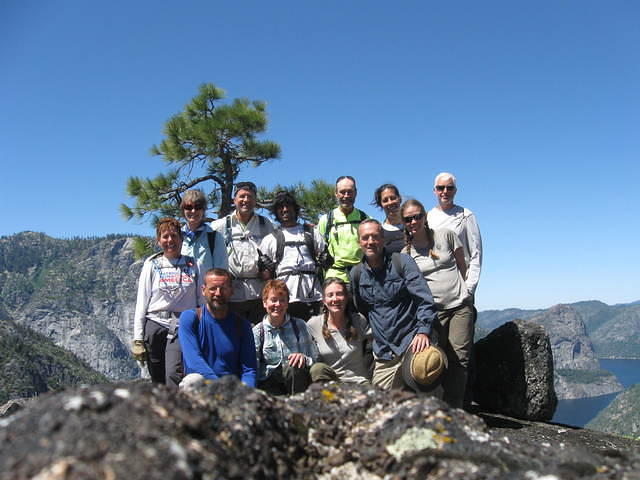
The award-winning WV Yosemite volunteers, June 2013. Photo by Dean Twehues
We just completed the 6th project in the Rancheria Falls area, in the Hetch Hetchy section of the Park. Our work includes removing and ecologically restoring inappropriate campsites, as well as removing non-native invasive species such as salsify, mullein and bull thistle from the Tiltill meadow, a remote high sierra valley with an abundance of wetlands and wildlife. The project requires volunteers to backpack in approximately 6.5 miles to base camp and an additional daily 6 mile roundtrip hike to get to the work site. Sadly, the Hetch Hetchy area is still being impacted by the massive Rim Fire, so we're sure our volunteer stewardship work will be greatly needed in the coming years.

Photo of Hetch Hetchy taken on the WV service project in Yosemite, June 2013 by Lawrence Herko

Dave Pacheco and Paul Goldberg of the WV staff will be on hand in Yosemite to accept the award. The award ceremony will be held on National Public Lands Day - Saturday, September 28th at 4pm in front of the Valley Visitor Center, and will be followed by a raffle and live music as part of the Park's 5-day Yosemite Facelift event. You are welcome to come celebrate with us! The 10th annual Yosemite Facelift is an effort to help clean-up the Park at the end of the busy summer season and runs from September 24 - 29.

Volunteers working in Yosemite, June 2013. Photo by George Ralston

See more photos from this project and more via the WV photo gallery.

Thursday, September 05, 2013

September is National Wilderness Month

The White House has recognized September as National Wilderness Month for the fifth year in a row! The proclamation by President Obama again sets September as the month to reflect on how important wilderness is for "our lives and our national character"and the timing is no coincidence.  The Wilderness Act was signed into law 49 years ago this month and the stage is being set for a grand national celebration of the 50th Anniversary next year. All of our service projects next season will be a celebration of this milestone legislation, as we continue our mission of giving something back.

An excerpt from the President's proclamation reads:
As natural habitats for diverse wildlife; as destinations for family camping trips; and as venues for hiking, hunting, and fishing, America's wilderness landscapes hold boundless opportunities to discover and explore. They provide immense value to our Nation -- in shared experiences and as an integral part of our economy. Our iconic wilderness areas draw tourists from across the country and around the world, bolstering local businesses and supporting American jobs.
During National Wilderness Month, we reflect on the profound influence of the great outdoors on our lives and our national character, and we recommit to preserving them for generations to come.
Read the full Presidential Proclamation here.

Photo by Jeff Cannon, taken on WV's service project in the John Muir Wilderness, Sierra NF, 8/11/13

Wednesday, August 28, 2013

Coming Back For More


We received this nice note from Glenn Thornton, a participant on WV's service project in Utah's Dark Canyon Wilderness of the Manti-La Sal National Forest, May 12 - 18, 2013.


Dave and Wilderness Volunteers,

Glenn conquering invasive tamarisk
Thanks for the fantastic opportunity to "give something back" on the 2013 service project in Dark Canyon. It truly was a rich and rewarding experience. This was my first WV trip and so I was not quite sure what to expect. Some volunteer/non-profit projects end up being a bit cobbled together logistics and communications wise. But with WV, I was very pleased to be able to have access to an up-to-date website with current info in the participants area, as well as the trip specific communications that were sent out to each participant. Then in the field you and Peyton had everything well planned and organized so that the hike in, and the camp-life was kept smooth and safe. And the food was quite good, varied and fresh, considering the remote location and all.

After all the hard work your crews have done in Dark Canyon and Woodenshoe Canyon, I felt honored to help WV and the USFS get one step closer to declaring victory over the evil tamarisk in Dark Canyon, at least in the wilderness portion of Dark Canyon. If all you guys offer is great volunteers, great leaders, great remote logistics, and seven days of hard and hot sandy work killing tamarisk while hiking in some of the most beautiful country around, then I'll definitely be back for more. Thanks again!

Glenn Thornton


While WV's next trip to Dark Canyon is already full, we'll likely be back in 2014. There are a just a few projects still in need of volunteers, such as a great project in the Moquith Mountain Wilderness Study Area by Kanab, UT and a neat one in the San Gabriel Mountains within the Angeles National Forest. Take a peek over on the WV project page for all the info on the service projects remaining in 2013.


Wednesday, August 14, 2013

Report From The Field: Sawtooth National Recreation Area


Report From The Field by Dave Pacheco

This past week, I co-led a group of intrepid Wilderness Volunteers into the rugged Sawtooth Wilderness to help the agency managing the Sawtooth National Recreation Area with some much-needed trail maintenance. We're proud to say this was WV's 15th project giving something back in the Sawtooths since 1999!

Under the long-time supervision of Liese Dean, Wilderness Program Coordinator, and Deb Peters, Assistant Trails Supervisor and expert packer, we backpacked in five miles to a campsite in the Stanley Creek area of the wilderness and immediately got familiar with our home for the week. Our first impressions were how incredibly clean the water flowed through this magnificent granite-based, Lodgepole pine forest -- some of the clearest water we had ever seen. And we couldn't help but be starkly reminded that the entire location, camp and work sites, were in a burned area from a 2007 fire.

For the next five days we made daily forays of up to eight miles round trip performing an assortment of
trail tasks. Volunteers took turns sawing out 55 downed trees across trails with a six-foot cross-cut saw, we lopped and brushed back overgrown vegetation from 5 miles of trail, and mostly we cleaned out debris and rocks from 244 water bars over that same distance. The water bar work was particularly important because of the unusual level of erosion from the past fire, and they are necessary to divert the water from gouging through trails.

Over the course of the week, we were thrilled with late night visits through camp by Mule deer and elk, and on the smaller scale we were entertained by pika, Clark's nutcracker, bluebird, and some very colorful Western tanagers. Thankfully, Thursday's storms that touched off wildfires across Idaho were well away from the immediate area, but they did make for some incredible evening red skies. The Sawtooth NRA is a place of many streams, deep glacial lakes, craggy peaks, and it's a place many of us will return to as we constantly explore wild America. If you're looking for a spectacular wilderness adventure, join us next year for another week in the Sawtooths!


Tuesday, August 13, 2013

Last Opportunities to Give Back with WV in 2013


Last week, we crossed the halfway mark for our 16th season of giving something back through weeklong service projects.  While there's still a large amount of work to be done, there aren't many spots available in the latter half of our season.  However, spaces are still available for these three neat places:

Mt. Rainier National Park, Sept. 8 - 14
Often referred to simply as "the mountain" by locals, Mt. Rainier is the most prominent topographical mountain in the contiguous United States. At 14,411' the massive stratovolcano can be seen from as far away as Portland, OR and Victoria, BC. Just under 60 miles from Seattle, the mountain and surrounding area offer tons of wilderness land to explore. Our service project in this very popular National Park is lending much needed restoration support to the Park Service. We will assist the restoration crew by transplanting native plant seedlings in subalpine meadows near the toe of Emmons Glacier. We will be car and tent camping down the road at White River Campground for the week, a developed site with amenities that is often noted for having breathtaking scenery. This is an active service trip appropriate for newcomers to backcountry volunteering and does not involve backpacking. Join us on the mountain in September.

San Gabriel Mountains Proposed Wilderness, Sept. 29 - Oct. 5

The San Gabriel Mountains are more than a scenic backdrop for the bustling city life of LA and the inland empire. These mountains support an interesting array of wildlife, many native species of plants benefiting from the range of microclimate and elevation variation, and also provide a much needed watershed for Southern California. Our service project in this proposed wilderness  is the removal of invasive Spanish Broom, which thrived following 2009's wildfires. We'll work with the Angeles National Forest's biology team to eradicate these invasives and also collect native seed for replanting.  Join us on the first WV project in the San Gabriels.


Big Bend National Park is unique as the largest protected area of Chihuahuan desert in the United States with more than 120,000 species of plants within its boundary. Lying on the Mexico border, the area offers an exceptional range of biodiversity with elevations ranging from 1,800' to more than 7,800'. The area offers much in the way of human history with archaeologists uncovering items dating back more than 9,000 years! Our service project will focus on trail maintenance and erosion controls on several key passages throughout the Park.  We'll stay in an established Park Service campground in the center of the Park, offering a great base to explore.  Learn more and join us on the last WV project of 2013, in Big Bend.


Friday, August 02, 2013

Katy Goes North

We're pretty fortunate at Wilderness Volunteers to work with and interact with an excellent group of dedicated volunteers.  We're grateful for all the hard work our participants put in, giving something back in precious wild spaces.

One such volunteer that we adore is Katy Giorgio. A longtime participant and WV leader since 2011, Katy takes amazing photos, gets a ton of work done and always is a joy to be around.  Not only that, she's a great writer and has a blog!  Her latest post is all about the weeklong service project on Admiralty Island in Alaska's Tongass National Forest. Check it out: Katy Goes North.

And you can see more of Katy's photos (and more) in our photo gallery as well.

Thursday, July 25, 2013

Peak Season for Volunteering

A new crop of leaders
It is one of those busy summer weeks for Wilderness Volunteers. We've got 4 projects out in the field right now, making a difference and giving back on a variety of wild lands.

There are two projects currently in Colorado and both are high-country backpack projects. There is a service project in the South San Juan Wilderness of the Rio Grande National Forest where participants are camped in a meadow adjacent to a creek at over 10,000'.  Just 10 miles from the New Mexico border on the eastern side of the Continental Divide in the Rockies, WV participants are reconstructing two bridges that have fallen into disrepair. The participants are rebuilding broken and rotted sections of the bridges and reinforcing with bolts and hand tools.

The other CO project is in the Holy Cross Wilderness of the White River National Forest. This project is a leader training trip, teaching WV participants all they need to know about how to lead WV projects on their own. And the participants are working on trail maintenance, building turnpikes and erosion controls in addition to learning how to ensure participants' safety, the proper ways to prepare and pack for a week's worth of meals for a dozen folks in the backcountry, how to practice and impart Leave No Trace ethics, how to ensure a safe and sanitary camp and much, much more. Quite a packed week and at high elevation in the Rocky Mountains no less.
WV leader trainees learn how to pack food for a weeklong service project in Minturn, CO
Also at significant elevation is the WV service project in the La Sal Mountains of Southeastern Utah.  A group of dedicated participants are currently out on the Moonlight Meadows trail working with a trail crew in the Manti-La Sal National Forest building erosion controls and water crossings before the late summer rains come on.  It's hard work at high elevation, but the view across wildflowered meadows down to the slickrock canyons below is quite nuturing.
WV participants and a Forest Service crew member pose by a reconstructed bridge in the La Sal Mountains
Perhaps if you squint hard enough, you can see the WV project underway up high in the La Sal Mountains
Augering while a deer scampers 

And up in Idaho, a WV group is working in the Mallard-Larkins Pioneer Area, helping the Nez-Perce Clearwater National Forest team maintain the Smith Ridge trail. Participants are cutting back overgrowth and clearing debris from the trail, while enjoying some breathtaking views.  Rumor has it a journalist may be stopping by the project, so we'll keep you posted on when that story appears.


Another busy week of giving something back.  We've got a few more weeks like this and we don't want you to miss out!  Check out the upcoming projects that still have availability on our website.

Wednesday, June 26, 2013

WV Celebrates WV's 150th


We know we're not the only WV out there.  The fine state of West Virginia is celebrating their sesquicentennial this week.  It's a state that has an abundance of wild lands and that's worth celebrating!  

This fall we'll be running our third consecutive service project in West Virginia wilderness. Our trip to the Dolly Sods wilderness is all full this year (you can always join the waitlist), so be sure to sign up early when next year's schedule is released.

A photo from WV's 2012 project in Dolly Sods Wilderness
In the meantime, our friends at The Nature Conservancy have released this travel guide to help you discover some of the great natural areas you can explore in the Wild and Wonderful state. Enjoy!


Thursday, June 06, 2013

WV Receives Presidential Volunteer Service Award


We were happy to receive this award and accompanying letter from President Obama in the mail this week.  This recognition was prompted by our agency partners at the Sierra National Forest, due to our continuing service project in the John Muir Wilderness.  Space is still available to join this project in California's Sierra National Forest, applauded by the White House, which runs August 11-17.

Sierra NF's Partnership Coordinator, Chor Yang, thanked WV for our "untiring commitment and unyielding dedication." We are grateful to all WV trip participants for joining in the effort to give something back as we celebrate and sustainably steward our country's wild lands.


Friday, May 31, 2013

These Boots Were Made For Walking by Dave Pacheco

I love my Danner boots! Two years ago I got a pair of Mountain Light hikers and they're now well worn-in and feel great. I've backpacked, day hiked, and generally use them around the yard as garden work boots. 

Despite having to go through back surgery last year, and worrying whether my footwear would continue to support a perhaps changed gait, my Danner boots made me all the more comfortable to get back into full outdoor activities. Me and my feet's best friends are going for a three day hike in Canyonlands this weekend! 

Here we are in the Dark Canyon Wilderness. Thanks, Danner!


Tuesday, May 14, 2013

WV Visits King Range NCA on California's Lost Coast

California's Lost Coast, photo courtesy of Eric Mak
In late April, a Wilderness Volunteers group trekked on an 8 mile backpack to a beachside campsite deep into the rugged Lost Coast of Northern California.  The Lost Coast is the longest stretch of undeveloped coastline in California. 68,000 acres are managed as the King Range Conservation Area by the Bureau of Land Management. The terrain is extremely rugged and the area experiences relatively frequent earthquakes due to the nearby Mendocino Triple Junction - the meeting of three tectonic plates just offshore.  Home to lush forests of Douglas-fir, Coastal Redwoods and Tanoaks, the area supports abundant wildlife including endangered coho and chinook salmon, steelhead trout and spotted owls.
Not a bad place for a hike, photo courtesy of Eric Mak

This was WV's inaugural service project with the King Range National Conservation Area. Participants worked on trail maintenance, including building new sections of trail and water crossings, as well as removing beach debris.

WV participants repair a major section of trail and build a water crossing, photo by Eric Mak
By all accounts the trip was successful! We received these kind words last week from Gary Pritchard-Peterson, the manager at King Range NCA.
We're very grateful for all the participants' hard work and are really looking forward to returning to the area next year!


Tuesday, May 07, 2013

WV Partners In the News - HawkWatch Intl and the Goshute Mountains

Check out this neat article in the May/June issue of Nevada Magazine about one of our partners, HawkWatch International.  WV's upcoming project June 2 - 8 in the Goshute Mountains is a combined project, as we'll work to maintain the trail used to access this important HawkWatch site.

Monday, May 06, 2013

My First WV Project

While I’ve come to get the know Wilderness Volunteers very well over the last half year as the organization’s first Development Coordinator, it wasn’t until the recent service project in America's newest national park, Pinnacles, that I got to experience WV in the field. It was a truly wonderful experience getting out into the wild to give something back as well as meeting a terrific group of dedicated volunteers and park personnel.

The WV group at Machete Ridge in Pinnacles NP
We arrived to the Pinnacles campground on the east side of Pinnacles on a warm Sunday afternoon after a lovely drive down highway 25, known as Airline Highway supposedly because pilots used the highway as a marker on the route from LA to San Francisco. The highway has beautiful rolling hills as it parallels the San Andreas Fault, which figures into how Pinnacles came to be. The exposed rocks of Pinnacles' peaks differ from these surrounding foothills, as it is part of the remains of a massive ancient volcano that was active 23 million years ago. As part of the Pacific Ring of Fire, the volcano was 15 miles long and nearly 8,000 feet high.  Surprisingly, the volcano was located nearly 200 miles to the southeast, just north of where LA is today. Due to the earth's tectonic plates colliding and shifting, the volcano was split and two-thirds of the remains have been pushed north to where it lies now.  As the plates moved, the mass sank and erosion has carved the impressive spires that are the Park's most recognizable feature. Surprisingly, the rocks continue to move towards San Francisco at the rate of a quarter of an inch per year.
Hard to believe these rocks made a 200 mile journey to get here.
After we all arrived and set up camp, the group began to get to know each other over our first fabulous meal prepared by Carleton Sheppard. Wonderful meals would become a regular occurrence during our week at Pinnacles thanks to Carleton.  The other half of our leader team, Bill Sheppard, then gave us a brief intro on what to expect for our first workday the following morning, when we would meet with the NPS staff.
On the hunt for thistle, Photo by Ulrich Boegli

After a hearty breakfast, we were introduced to the park by NPS staff Brent, Lucy and Esperanza, who gave a great overview of the Park's features, history, conservation management goals and potential hazards to be aware of during our time in the backcountry. We were then given leather work gloves, counters, hiking poles and snake chaps as we set out to begin our week hunting for invasive plants throughout the park. Lucy and Esperanza would be our guides for the week and we began by searching from the Bear Gulch area back to campground for invasive Italian Thistle.  We scoured hillsides and walked along a wide seasonal creek bed filled with native poppies. After lunch we spread out to scour through a section of forest until one of our volunteers, John, found the mother load of thistle. We all joined together in an approx. 40' x 40' area to pull thousands of this invasive weed that has been choking out native species.

Tuesday was our free day, since there was a meeting that required attention from NPS staff and we split into groups to climb into the heart of the park via the High Peaks Trail, sadly leaving behind one of our compatriots at camp who was feeling under the weather. Despite leaving at different times and taking slightly different routes, our group met up at the Scouts Peak lookout that offered views to the west of the Salinas Valley and the Santa Lucia Mountains that lie run along the coast. We then climbed the steep and narrow section of the trail, which was exhilarating!  Yet another fabulous lunch was followed by nice views of the Balconies section of the park and then venturing down Condor Gulch trail, which gave terrific views of the rocky crags and spires. Tuesday also was the first time for confirmed sightings of one of the park's other claims to fame - home to the endangered California Condor.


Wednesday morning was the coldest of the week, reaching just above freezing.  While the cool nights
There's invasive mustard under there.
generally offered a nice respite to the hot and dry 90 degree days, this was a very chilly morning. We warmed ourselves by a nice morning fire before taking off on one of the longer hikes of our time in the park. Departing from the Old Pinnacles trailhead, we walked north of the high peaks we had climbed the day before, along the relatively level Chalone Creek - named after the indigenous people who lived in the area. All week long we saw many beautiful birds and butterflies, and this day was no exception. After reaching the entrance for the West side of the park, we went off-trail to attack the other invasive plant we would hunt during our time at Pinnacles - invasive mustard.  We found many mustard plants, some right as they were flowering, preventing the plants from reaching the bolting stage. All the while, we had terrific views of Machete Ridge. After successfully removing several thousand mustard plants, we trekked back to the eastside of the park, passing through Balconies Cave. The caves in Pinnacles are another fun feature of the Park.  They are above-ground Talus caves, formed by falling boulders and rocks trapped in steep canyons.  The caves are partially closed to protect the bat populations that make their home there and are fully closed to the public during breeding season.

Thursday was a fascinating day as we were introduced to Alacia Welch, one of the Park's Condor Biologists. Alacia led us to areas of the Park normally closed to the public.  We ventured up a steep road to a ridge where we would continue our hunt for invasive plants. Working along steep terrain, we were treated to views that few visitors to Pinnacles see.  We also watched a young condor perch in a tree nearby the NPS facility and then watched as it took flight over our heads. Their wingspan is seriously impressive. We asked Alacia every question we could think of, and weren't able to stump her. We toured the condor facility and saw how they trap and release birds, and monitor the birds through one-way mirrors.
Alacia answered every question we could think of.
The California Condor was very nearly extinct due to poaching, lead poisoning and habitat destruction - with only a population of 22 in the wild in the 80s. A controversial captive breeding program began in 1987 by the government and continues to this day. Pinnacles is an important site for monitoring the health of the population, with other important sites in Southern California, Baja and Arizona.  Those original 22 birds were given numbers #1-22 and tagged with monitors. The population has now reached more than 400, with more than 200 living in the wild.  

We also assisted Alacia by moving brush to cover exposed water lines that had recently been installed by the facility. We then continued to hunt for invasive plants and took an adventurous off-trail route down the mountain and back to the campsite.
Our group covered the line behind this way neat condor facility
Friday was our last work day, but it proved to have some of the most impressive scenery of our time at Pinnacles.  We began by traveling through the Bear Gulch caves and reaching the bear Gulch Reservoir - a man-made reservoir to be used in case of fire protection. We then ventured off-trail into backcountry canyons, searching for more invasive plants, finding both thistle and mustard, as well as hundreds of butterflies, birds and a snake or two.


My first WV service project was an absolute blast. By my estimates we pulled more than 10,000 invasive plants, covered over 30 miles of hiking and saw a terrific array of flora and fauna. My biggest takeaway, however, was how wonderful all the participants were! Our leaders, Bill and Carleton, were fantastic and kept us safe and well fed. All the volunteers were lovely folks, had a wonderful attitude and really embodied the spirit of giving something back.  I can't wait for my next WV trip!


Wednesday, May 01, 2013

Thursday, April 11, 2013

Great Places to Give Something Back


Our 16th season of giving something back is now underway and there are still available spots on service projects in some seriously great wild places:


Alta Toquima Wilderness, June 23-29

This amazing central Nevada wilderness area lies in the middle of the Toquima Mountain range as part of the Humboldt-Toyaibe National Forest (largest NF in the lower 48). Offering excellent hiking and majestic sweeping views, the area offers amazing Great Basin recreation. Our service project will be general trail maintenance in lush Pine Creek Canyon and camping in an established campsite.  Learn more and join WV at Alta Toquima.


While the Mallard-Larkins Pioneer Area lacks formal wilderness designation, it does NOT lack for wild beauty.  The area's 30,00 acres are part of a larger section of 260,000 roadless acres in north central Idaho that features rugged landscape, many fantastic lakes and impressive biodiversity. The service project will focus on general trail maintenance from an established campsite that offers striking panoramic views. Join us in Mallard-Larkins.

Sawtooth National Recreation Area, Aug. 4-10 

Central Idaho's Sawtooth National Recreation Area and surrounding White Cloud Mountains have a breadth of terrific recreational opportunities, including top-notch hiking, biking and fishing. You'll fall in love with the area's natural beauty and the wide-range of flora and fauna that the area supports. Our service project is a backpacking trip in lush and narrow Little Casino Creek Canyon, where we'll be doing trail maintenance to keep this trail open and passable. Learn more about the WV project in the Sawtooth NRA


Backpacking in the Southwestern Colorado Rockies is a thrilling experience and the WV service project in the Weminuche Wilderness is no exception. With several peaks topping 14,000', this rugged wilderness lies across the San Juan National Forest on the west of the divide and the Rio Grande National Forest on the east. The WV trip will work on the CDT from a basecamp of 11,500 containing erosion on one of the continent's great trails. Learn more and join us in the majestic Weminuche Wilderness.


Jedediah Smith Wilderness, Aug. 25-31

Travelers comes from around the world to reach the storied and sometimes crowded parks of Yellowstone and Grand Tetons and experience the Greater Yellowstone Ecosystem. On the west side of the Teton range, stretching across the Wyoming and Idaho border lies the lush forests and gradual rise of the Jedediah Smith Wilderness, offering outstanding biodiversity without the crowds. We'll backpack in several miles and work on the Hominy Peak trail, rerouting and building erosion controls to keep it accessible. Join us in the spectacular Jedidiah Smith Wilderness.


While many deserts are lively ecosystems, few can match the wide range of flora and fauna of southern Arizona's Saguaro National Park.  Boasting more than 900 species of plants, over 200 species of birds and countless other biological fascinations, this globally unique ecosystem is an area not to be missed.  Our project is in the Rincon Mountain Wilderness, that rise high above the Sonoran desert and offer changing temperatures. We'll camp by our vehicles at the base of the mountains and hike up the Rincons working on trail maintenance of the Miller Creek trail. Learn more and join us in Saguaro National Park.


San Gabriel Mountains Proposed Wilderness, Sept. 29 - Oct. 5

The San Gabriel Mountains are more than a scenic backdrop for the bustling city life of LA and the inland empire. These mountains support an interesting array of wildlife, many native species of plants benefiting from the range of microclimate and elevation variation, and also provide a much needed watershed for Southern California. Our service project in this proposed wilderness  is the removal of invasive Spanish Broom, which thrived following 2009's wildfires. We'll work with the Angeles National Forest's biology team to eradicate these invasives and also collect native seed for replanting.  Join us on the first WV project in the San Gabriels.


Big Bend National Park is unique as the largest protected area of Chihuahuan desert in the United States with more than 120,000 species of plants within its boundary. Lying on the Mexico border, the area offers an exceptional range of biodiversity with elevations ranging from 1,800' to more than 7,800'. The area offers much in the way of human history with archaeologists uncovering items dating back more than 9,000 years! Our service project will focus on trail maintenance and erosion controls on several key passages throughout the Park.  We'll stay in an established Park Service campground in the center of the Park, offering a great base to explore.  Learn more and join us on the last WV project of 2013, in Big Bend.