Showing posts with label invasive species. Show all posts

Monday, April 04, 2016

Project Spotlight: Yosemite National Park


Combing the meadows
Yosemite National Park stretches across the western slopes of the Sierra Nevada mountain range, spanning nearly 1,200 square miles. Our nation's third national park, Yosemite is widely known for its magnificent rock formations, grassy meadows, crystal-clear streams, majestic waterfalls, rushing rivers, ancient giant sequoia trees, and abundant wildlife.

Over 90% of the park is designated as wilderness, providing a phenomenal variety of growing conditions and habitat for more than 1,450 native plant species.

Our ninth year service project will take place June 5-11, 2016 in the beautiful Hetch Hetchy section of the park. Carved by glaciers and drained by the Tuolumne river, the Hetch Hetchy Valley lies in the northwestern part of Yosemite National Park and contains some of the tallest waterfalls in North America: Wapama Falls, at 1,700 ft (520 m), and Tueeulala Falls, at 840 ft (260 m).

Western Salsify
Our continuing project in Yosemite is removal of several species of invasive weeds such as wooly mullein, bull thistle and western salsify. These invasive plants have the potential to rapidly displace native plants, alter fire regimes, and/or significantly alter ecosystem structure or function.

Common mullein
Because of the complex ecological relationships among native organisms, impacts to native plant communities can negatively affect associated wildlife throughout Yosemite. Invasive plants are prioritized for control based upon the threat they pose and the park's capabilities for successful control. Find out more about non-native species in Yosemite and what you can do to help here.

Project participants will hike in approximately 6.5 miles around the northern shore of the Hetch Hetchy reservoir to Rancheria Falls and set up a basecamp. The hike in is a scenic treat with a modest elevation gain that includes hiking over a dam, through a short tunnel, across a few foot bridges, under some spectacular waterfalls, and maybe even a mist rainbow or two.

Hiking along the reservoir

Wapama Falls
A refreshing mist rainbow
A visitor in camp
From our basecamp we will hike approximately 3 miles to and from grassy meadows in the area each day to work. We'll also likely conduct a day of campsite restoration in the backpackers camp ground at Rancheria Falls. The Park Service will provide pack support to carry the tools, food and commissary gear to camp.

Weed warriors!
Come spend a week in beautiful Yosemite National Park and give something back to our nation's wild lands with Wilderness Volunteers! You can get more information and register for our Yosemite project here. For information about our other 2016 projects visit our website. See more great photos from previous WV Yosemite service projects over at the WV Photo Gallery.

Hiking to work 

Saturday, September 12, 2015

Spend a Week in Paradise & Take a Walk in the Clouds

Koke'e State Park, Kauai, Hawai'i (Oct 4th - Oct 10th 2015)

Located north of Waimea Canyon on the west side of Kauai, Koke'e State Park covers over 4000 acres of fluted cliffs, lush green tropical rainforest and cloud covered bogs at an elevation of roughly 3000 to 4000 feet above sea level.


With over 45 miles of hiking trails through cloud forests covered in mosses and ferns, Koke'e State Park is an excellent spot to see native Hawaiian plants (like koa, 'ohi'a, and mamane trees) and colorful endemic Hawaiian forest birds (like the apapane, i'iwi and 'amakihi).

Koa trees can reach heights of well over 100 feet.
I'iwi are bright orange-red and have long curved bills.
Apapane rely heavily on the nectar of 'ohia blossoms.
Beautiful 'Ohi'a trees are common in Hawai'i
Mamane trees can grow to over 50 feet and prefer higher elevations.
 'Amakihi are green-yellow Hawaiian honeycreepers.

Akala (giant Hawaiian raspberry)
Koke'e's ecologically rich high elevation forests are truly unique in the world and are in need of protection from invasive plants which threaten their existence.

On the Wilderness Volunteers Koke'e trip our service project will focus on the removal of non-native, invasive plants and vines such as Kahili ginger, Strawberry guava, Firetree, and Banana poka.

Our partner organization on this project is the Koke'e Resource Conservation Program, a volunteer based alien species control program working in cooperation with the HawaiĘ»i Department of Land & Natural Resources State Parks Division.

The Banana Poka is an aggressive woody vine that can entangle and kill large stands of forest.   
Learn more about Kauai’s native plants, flowers, trees and birds in the cloud forests of Koke'e with Wilderness Volunteers!

Read more about the area and the project here.

Tuesday, April 28, 2015

Project Videos: Pinnacles NP, Mojave NP, Pt. Reyes NS


Veteran Wilderness Volunteer Tom Coroneos has done more than 20 projects giving back all over the country! And beyond being an excellent volunteer, he's terrific at making movies, having put together many great videos, including several about his recent WV projects! Take a gander at Tom's excellent work below:

Pinnacles National Park 2015

Mojave National Preserve 2015

Pt. Reyes National Seashore 2014

Mojave National Preserve 2014

And Tom is currently out in the field at the Pt. Reyes National Seashore project, so we can likely count on another video coming our way soon. Thanks Tom!


Wednesday, October 30, 2013

A Transformational Trip To Escalante by Rebecca Glucklich

Yes, I am “that girl” who decided to go to Utah after reading Aron Ralston’s “Between a Rock and a Hard Place” and watching 127 Hours – I was mesmerized by the slot canyons, the vast expanses of empty desert, the hoodoos – it just looked other-worldly. I would occasionally pop online to see if there were any guided trips to Moab or the surrounding areas – I was smart enough to know that I really shouldn’t trek alone since I have quite a fondness for my limbs, but everything was out of my budget or just not at the right time. This past February, I was visiting my parents and going on about Utah when my dad pointed out that I’d been talking about taking a trip out west for years now and I just needed to “make it happen already!” On a whim, I Googled “Utah volunteer trek” and lo and behold, the WV site popped up in my search results. Little did I know that this Google search would change my life.

For the months leading up to my departure date, I got a ton of “You’re going WHERE? To do WHAT?” from friends, co-workers, really anyone who I told I was going to Utah to chop down Russian Olive trees. But I also got a lot of “wow – you’re brave!” I spent my lunch hours searching for gear online and around my office, and thankfully had friends to lend me a sleeping bag and one adventurous sister to lend me a tent. Yes, I was nervous and had no idea what to expect, but just knowing that I’d really wanted something and made it happen gave me the boost I needed to make the solo journey to Escalante.

Upon arriving after a 6 hour car trip with one of my fellow volunteers, I was pleasantly surprised to see that our camp site was complete with bathrooms and showers, a fresh water pump and a glorious, sparkling albeit freezing cold reservoir. Hardly what I’d call “roughing it” but it was a good way to ease back into outdoor life. After all, I hadn’t been on a real camping trip in over a decade. I was immediately welcomed into the group, who were also a bit astonished that I had just hopped on a plane and left Boston for a week in the desert without knowing a soul. These folks would soon become my dear friends and confidants for my week long adventure and I could tell by the first dinner that I was going to have the best week ever. 

The work is hard. Really hard. 6 or so hours a day in the desert heat sawing, loping, hauling and chopping these beasts of trees with thorns so sharp they’ll go right through your shirt (I have a few battle scars to prove it.) But after my first day, I felt more relaxed and at ease than I had been in years and apparently left some of my inner aggressions out by the banks of the Escalante River. I wasn’t thinking about my job or my personal life or Facebook (although, I was a little relieved to have wireless at night to post some stellar pics!). Every day, though the hike to and from the worksite got a little longer, the days seemed to fly by. I spent one whole morning in and by the river working on deconstructing a massive snarl of Russian Olive trees, river debris and probably a few other types of plants and trees. When the Russian Olive was finally cleared out enough for the sawyers to take down, it was the most exhilarating and satisfying feeling in the world. To quote one of my other favorite books, “I swear we were infinite.” (The Perks of Being a Wallflower)


After a week of sawing, chopping, exploring slot canyons, searching for pictograms, staring at the night sky and falling asleep to the LOUDEST frogs ever, it was time to go home. As I made my rounds of hugs and goodbyes to my new friends, including my fearless leaders Dudley and Chris, I couldn’t help but feel a little heaviness in my chest. I grew so close to this group of strangers in such a short amount of time and had a feeling that although we may be scattered around the country, we’d keep in touch and even see each other again on a future WV trip. Even now, as I write this, I must admit, my eyes are tearing up a bit remembering what an incredible time I had. 

Within a week of my return, not only was I offered a new job at a new organization, but many of my friends remarked that I seemed much more relaxed and happy. I came home with such a sense of accomplishment, a feeling that I really can do whatever I set my mind and heart to. I truly felt as if my life had been changed and I have WV to thank for that. I don’t know if any WV trip will top my first one, but I will certainly do my best to try!


***

The 2014 Wilderness Volunteers spring schedule is available now, including service projects in the Grand Staircase-Escalante National Monument and along the Escalante River in the Glen Canyon National Recreation Area. We invite you to join us in giving something back and experience the loudest frogs ever.

Thursday, September 12, 2013

WV Honored as Yosemite Volunteer Group of the Year


Wilderness Volunteers has been selected as the Volunteer Group of the Year by Yosemite National Park!

With over 9,500 volunteers donating their time and energy in Yosemite this year, it is a great honor to be chosen as the best of the year. We're grateful for the hard work of all of our volunteer participants and especially the project's leaders, Dean and Laurie Twehues. Victoria Hartman, Yosemite's Wilderness Restoration Coordinator, recognizes the group by saying, "Your work is critical to the park’s ability to protect and preserve our rich natural and cultural heritage while providing meaningful and enjoyable experiences for our visitors." All participants will be receiving a thank you gift from the Park as part of the award.

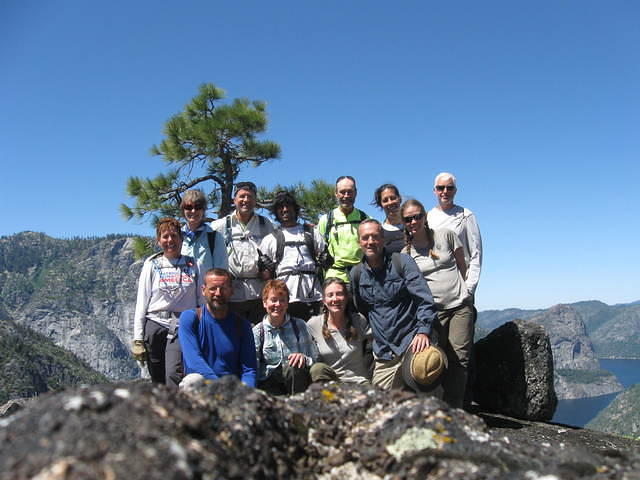
The award-winning WV Yosemite volunteers, June 2013. Photo by Dean Twehues
We just completed the 6th project in the Rancheria Falls area, in the Hetch Hetchy section of the Park. Our work includes removing and ecologically restoring inappropriate campsites, as well as removing non-native invasive species such as salsify, mullein and bull thistle from the Tiltill meadow, a remote high sierra valley with an abundance of wetlands and wildlife. The project requires volunteers to backpack in approximately 6.5 miles to base camp and an additional daily 6 mile roundtrip hike to get to the work site. Sadly, the Hetch Hetchy area is still being impacted by the massive Rim Fire, so we're sure our volunteer stewardship work will be greatly needed in the coming years.

Photo of Hetch Hetchy taken on the WV service project in Yosemite, June 2013 by Lawrence Herko

Dave Pacheco and Paul Goldberg of the WV staff will be on hand in Yosemite to accept the award. The award ceremony will be held on National Public Lands Day - Saturday, September 28th at 4pm in front of the Valley Visitor Center, and will be followed by a raffle and live music as part of the Park's 5-day Yosemite Facelift event. You are welcome to come celebrate with us! The 10th annual Yosemite Facelift is an effort to help clean-up the Park at the end of the busy summer season and runs from September 24 - 29.

Volunteers working in Yosemite, June 2013. Photo by George Ralston

See more photos from this project and more via the WV photo gallery.

Wednesday, May 01, 2013

Thursday, April 11, 2013

Great Places to Give Something Back


Our 16th season of giving something back is now underway and there are still available spots on service projects in some seriously great wild places:


Alta Toquima Wilderness, June 23-29

This amazing central Nevada wilderness area lies in the middle of the Toquima Mountain range as part of the Humboldt-Toyaibe National Forest (largest NF in the lower 48). Offering excellent hiking and majestic sweeping views, the area offers amazing Great Basin recreation. Our service project will be general trail maintenance in lush Pine Creek Canyon and camping in an established campsite.  Learn more and join WV at Alta Toquima.


While the Mallard-Larkins Pioneer Area lacks formal wilderness designation, it does NOT lack for wild beauty.  The area's 30,00 acres are part of a larger section of 260,000 roadless acres in north central Idaho that features rugged landscape, many fantastic lakes and impressive biodiversity. The service project will focus on general trail maintenance from an established campsite that offers striking panoramic views. Join us in Mallard-Larkins.

Sawtooth National Recreation Area, Aug. 4-10 

Central Idaho's Sawtooth National Recreation Area and surrounding White Cloud Mountains have a breadth of terrific recreational opportunities, including top-notch hiking, biking and fishing. You'll fall in love with the area's natural beauty and the wide-range of flora and fauna that the area supports. Our service project is a backpacking trip in lush and narrow Little Casino Creek Canyon, where we'll be doing trail maintenance to keep this trail open and passable. Learn more about the WV project in the Sawtooth NRA


Backpacking in the Southwestern Colorado Rockies is a thrilling experience and the WV service project in the Weminuche Wilderness is no exception. With several peaks topping 14,000', this rugged wilderness lies across the San Juan National Forest on the west of the divide and the Rio Grande National Forest on the east. The WV trip will work on the CDT from a basecamp of 11,500 containing erosion on one of the continent's great trails. Learn more and join us in the majestic Weminuche Wilderness.


Jedediah Smith Wilderness, Aug. 25-31

Travelers comes from around the world to reach the storied and sometimes crowded parks of Yellowstone and Grand Tetons and experience the Greater Yellowstone Ecosystem. On the west side of the Teton range, stretching across the Wyoming and Idaho border lies the lush forests and gradual rise of the Jedediah Smith Wilderness, offering outstanding biodiversity without the crowds. We'll backpack in several miles and work on the Hominy Peak trail, rerouting and building erosion controls to keep it accessible. Join us in the spectacular Jedidiah Smith Wilderness.


While many deserts are lively ecosystems, few can match the wide range of flora and fauna of southern Arizona's Saguaro National Park.  Boasting more than 900 species of plants, over 200 species of birds and countless other biological fascinations, this globally unique ecosystem is an area not to be missed.  Our project is in the Rincon Mountain Wilderness, that rise high above the Sonoran desert and offer changing temperatures. We'll camp by our vehicles at the base of the mountains and hike up the Rincons working on trail maintenance of the Miller Creek trail. Learn more and join us in Saguaro National Park.


San Gabriel Mountains Proposed Wilderness, Sept. 29 - Oct. 5

The San Gabriel Mountains are more than a scenic backdrop for the bustling city life of LA and the inland empire. These mountains support an interesting array of wildlife, many native species of plants benefiting from the range of microclimate and elevation variation, and also provide a much needed watershed for Southern California. Our service project in this proposed wilderness  is the removal of invasive Spanish Broom, which thrived following 2009's wildfires. We'll work with the Angeles National Forest's biology team to eradicate these invasives and also collect native seed for replanting.  Join us on the first WV project in the San Gabriels.


Big Bend National Park is unique as the largest protected area of Chihuahuan desert in the United States with more than 120,000 species of plants within its boundary. Lying on the Mexico border, the area offers an exceptional range of biodiversity with elevations ranging from 1,800' to more than 7,800'. The area offers much in the way of human history with archaeologists uncovering items dating back more than 9,000 years! Our service project will focus on trail maintenance and erosion controls on several key passages throughout the Park.  We'll stay in an established Park Service campground in the center of the Park, offering a great base to explore.  Learn more and join us on the last WV project of 2013, in Big Bend.

Thursday, February 07, 2013

Natural Bridges National Monument


By Chris Stockdale
For the three first-time volunteers with WV, the service week at Natural Bridges National Monument in Southeastern Utah was an inspiring introduction to the organization and the contributions it makes to maintain our wilderness areas, national monuments, and parks. In addition to our capable and friendly leaders, the ‘newbies’ could pick the brains of the other volunteers, all of whom had participated in numerous other service trips. The enthusiasm of the eleven participants, ranging in age from the 20’s to 60’s, was amazing. They came from all around the country, and some were experiencing Utah’s stunning canyon country for the first time.

Our project was to eradicate the invasive tamarisk growing along the creeks running through the spectacular canyons of the area. To our surprise, there weren’t as many plants to cut down and treat with herbicide as we anticipated. Because we were searching for tamarisk we spent more time hiking the canyons of what is the smallest National Monument in the United States, and we had the chance to see all the natural bridges up close. We worked alongside two park rangers, and on our last day of work, ranger Jim took us on a hike up a less visited, though equally beautiful, canyon.

For the most part the weather was beautiful. We did endure one rain storm, but as is common in the desert, it was short-lived, and we were still able to get some more hiking under our belts. We agreed that it had been an enjoyable week and all the first-timers stated they would be signing up for more trips. The standouts for veteran volunteer Selma Kristel were the secluded camping area, lively talks about our trips to exotic places and the chance to explore remote parts of Natural Bridges. On our last night in camp, Jim came by to thank us profusely for all the help the volunteers had given him and his staff. We all left on Saturday knowing that we had in a small way helped to rid this magnificent monument of an invasive plant.

Wednesday, February 06, 2013

Project Spotlight: Mojave National Preserve

A Joshua Tree in Mojave sunset light, photo by Paul Goldberg

Today we spotlight the WV project in the vast Mojave National Preserve, the 3rd largest unit of the National Park System in the contiguous US. Formerly named the East Mojave National Scenic Area and managed by the Bureau of Land Management, these striking 1.6 million acres were established as a preserve on Halloween in 1994 by the California Desert Protection Act, including a 695,000 acre wilderness area. Nestled between highways 15 and 40, the area offers many, many fascinating features and so much to explore. Towering mountain ranges present “sky island” forests of pinyon pine and white fir over great mesas, dry river beds and low-lying deserts featuring impressive sand dunes and beautiful Joshua tree forests.

Hole-in-the-Wall, photo courtesy of the US Dept. of the Interior
An intriguing human history is here to explore alongside unbelievable geological and ecological fascinations. Notable features include the Kelso Dunes, the Marl Mountains and the Cima Dome, which features the largest and densest stand of Joshua trees in the world. Striking volcanic formations such as Hole-in-the-Wall and the Cinder Cone Lava Beds speak to the incredible geology.  2.5 billion year old rocks have been found on the Clark Mountains.

The abandoned Post Office in the ghost town of Kelso, photo by Pierre Camateros
More recent human history can be seen in the preserve’s ghost towns, abandoned mines and the Kelso depot, now part of the visitor center.  Prior to European contact, Mojave tribes such as the Chemehuevi, lived in the mountains and along the Colorado river eating prickly pear, mesquite and roasted agave blooms and hunting deer and bighorn sheep.

A local Mojave tour guide, photo by Paul Goldberg

This dragonfly tried to hitchhike on my car's antenna, photo by Paul Goldberg

Despite appearing as a relatively barren landscape, the area is teeming with varied and interesting animal life including many species endemic to region or otherwise rarely found outside of the preserve. One such example is the Mojave Fringe-toed Lizard (Uma scoparia), which is specialized in its ability to "swim" under sand.

Birds, reptiles, rodents, and larger mammals all reside in the area, although where you might find them varies due to temperature, time of day and elevation. A large percentage of desert animals are nocturnal, or active at night, including desert rodents, bats, owls, mountain lion, skunks, and foxes. Other animals in the Mojave are crepuscular, active at dawn and dusk.


Mojave Desert Tortoise populations are threatened, partly because of invasive plants, photo courtesy of NPS
The low regions of the Preserve are arid, with creosote bushes dominating the landscape on over 70% of the Preserve, while the mountains offer varied environments with cooler temperatures.  The service project we’ll be working on will be critical in removing invasive species of Russian thistle at the key moment before they go to seed. We will use a hula hoe, a tool specifically designed for removing thistle. We’ll camp at a comfy developed campsite with running water in the mountains which will serve as a prime location for the project as well as offering plenty of interesting options for us to explore in our free time. Learn more about the WV project in the Mojave National Preserve.

The beautiful solitude of the Mojave National Preserve, photo courtesy of the NPS

Friday, August 05, 2011

Update on 2010 Hawksbill Nesting Season
guest post by Ashely Northcutt


In March of 2010, I was lucky enough to co-lead a Wilderness Volunteers trip to Halape beach in Hawaii Volcanoes National Park. We backpacked about 8 miles in over some fantastic lava down to the coast line and spent a week removing invasive vines and trees. These trees/vines have been creeping in further every year and are significantly reducing the available real estate on the beach for the mother turtles to nest (not to mention keeping the tiny babies from reaching the ocean after they hatch).
The Hawaii Island Hawksbill Turtle Recovery Project reports that the last nest of the 2010 season hatched in mid-January 2011. Between April and January, 40 nests from 13 turtles at six different beaches (including Halape!) were documented on the southern coast of Hawaii.


They are estimating that 4000 baby turtles made it to the ocean.

Hooray!!!! :)

I'm proud to have been a part of this fantastic work project and greatful that Wilderness Volunteers made it possible.

Ashely Northcutt

Tuesday, July 06, 2010

Invasive Species...and Kitchen Corner

Every region of the country has invasive plants that present their own particular problems. When my wife and I moved to a state in the Deep South shortly after we married, we encountered Kudzu for the first time. Kudzu was introduced from Japan into the United States in the nineteenth century and was promoted as a forage crop and an ornamental plant. In the 1930s, farmers in the southeastern United States were encouraged to plant Kudzu to reduce soil erosion. The plant wasn’t considered a pest weed until 1953, and now this invasive swallows up houses if not kept in check. Tumbleweed, the plant so associated with desolate Western landscapes in movies, is an invasive as well, probably having arrived in the United States in seed shipments. Other invasive plants such as Russian Olive and Tamarisk (salt cedar) were purposely introduced to the United States and have become severe problems along many waterways in the western part of the country. In the Northwest, we have English Ivy as well as Scotch Broom to contend with. It is probably not news that no section of the country is free from invasive plants.

Given the pervasiveness of invasives, why even discuss them here? Although most invasives will never be eradicated from environments where they can thrive and crowd out native plants, we can do things to lessen their spread to sensitive areas. Wilderness Volunteers participants join our 50 or so trips each year and come from all over the country to do so. Unwittingly, many of these well-meaning participants may be helping spread invasives or introducing plants from their region of the country into regions where these plants are unknown. The most common way this happens is through seed dispersal, and we humans often become the vehicles for this dispersal.

What can you do as an individual? The simplest thing you can do is check your boots before leaving home for that camping or backpacking trip and make sure the soles are clean. Do the same just prior to leaving your camping/backpacking location to return home. Check your clothing as well. Many seeds can easily attach themselves to clothing or even get into pockets. If you can’t effectively clean your boots and clothing prior to heading home after a trip and have to wait until you get home to do so, there are still ways to prevent seeds from potentially germinating in a new environment. Clean boots and clothing somewhere where the soil and plant matter can be contained; then soak the plant matter in bleach before disposing of it. As volunteers who often enter sensitive wilderness areas, we don’t want to be unsuspecting agents who introduce non-native plants to an area whether it be that wilderness area or our own home territory. Below are some links to sites with more detailed information.

http://www.ucsusa.org/invasive_species/what_you_can_do/what-you-can-do-to-prevent.html


http://www.fws.gov/invasives/what-you-can-do.html


http://www.fs.fed.us/invasivespecies/prevention/index.shtml

http://www.nature.org/initiatives/invasivespecies/


PASTA AND GARBANZO BEAN STEW
Olive oil
2 cups crushed tomatoes with added puree
4 garlic cloves
3-4 tablespoons fresh or dried rosemary
8 cups vegetable broth (use 4 Knorr Vegetarian Bouillon cubes in water)
4 15-16 oz. cans garbanzo beans, drained and rinsed
12 oz. Fettuccine in one inch pieces
Parmesan cheese

Heat oil in large pan. Add tomatoes, garlic, and rosemary. Simmer 5 minutes. Add broth and garbanzo beans and stir to blend. Bring to boil and add the fettuccine. Simmer until pasta is tender. Season with salt and pepper. Add parmesan separately.

Sunday, December 06, 2009

The Great Escalante Flood of 2009

Escalante River Canyon, UT (2009)

When he's not teaching Latin American Literature at UC San Diego, Wilderness Volunteer trip leader Misha Kokotovic is busy battling invasive Russian Olive trees - notorious for choking off rivers and streams in the West - along Utah's Escalante River. His first WV trip led him to the Escalante in 1999, and he's been going back almost every year since - including this past year, which proved to be his most exciting trip yet.

"Near the end of our second day of work in the Escalante River canyon, we hear someone a few hundred yards downstream from us shouting. It’s someone from our group, so maybe he’s announcing that it’s quitting time. But the tone sounds more urgent than that, and some of us think we might have heard him shout the word “Flood!” That’s not implausible since it’s been cloudy all afternoon, and there were even a few drops of rain. The Escalante River had already risen a couple of inches over the course of the afternoon, which was enough to convince us to have everyone work on the river bank closest to camp so that nobody would get stranded for the night if there were a serious flood. So, yes, maybe he has been shouting “Flood!”

But we’re upstream of the shouting and see no sign of the river above us rising any further than it already has. Then we hear it: a steady roar downstream, which drowns out the shouting. All doubt is erased as the Escalante River reverses course and begins to flow upstream, carrying with it the Russian Olive branches we had cut over the past two days. Yes, there has in fact been a flood, but not the one we expected.

Rather than coming down the main Escalante drainage, the flood has come down the tributary drainage of Choprock Canyon. And our camp, our food, our tents – everything – is on the other side of Choprock, out of reach until the flood waters recede. Despite our precautions, it’s beginning to look like at least some of us may be going to bed hungry and without our camping gear.

We hike towards camp and gather on the river bank directly across from our tents, yet not everyone is accounted for. We can see one lucky group member who somehow ended up on the other side of Choprock and now waves to us from camp. Most of our group waits on the bank while a few of us hike back to the Escalante River to look for the missing, to no avail. We then walk up the Choprock drainage along the canyon rim and spot a group member on the opposite rim. After much gesturing and shouting over the flood waters below, we learn that two group members have been stranded farther up Choprock Canyon. Soon we’re on the rim above them and, after more gesturing and shouting, we’re reassured that they are safe and even enjoying the flood. Finally, the remaining members of the group, including Park Ranger Bill Wolverton, join us on the canyon rim. We’re all relieved that everyone has finally been accounted for, and it’s now time to reconstruct what happened.

Spotting the flood first were three volunteers who had quit work early in order to hike up Choprock Canyon in search of clear water for drinking and cooking (our main water source, the Escalante River, had become very muddy the day before). As they were filling the water jugs, they heard and then saw the flood racing down the canyon. Two were stranded on opposite banks of Choprock, while the third managed to outrun the flood and warn the rest of us – hence, the shouting we heard. Ranger Bill and another volunteer were the first to hear the warning and see the flood spill over into the Escalante River, overpowering the current and reversing the flow for several hundred yards upstream. Caught on the far bank of the Escalante, they hiked upstream to a safer crossing, and joined us on the rim of Choprock Canyon.

With everyone accounted for, but still separated from camp by a rising river, all we could do was ensure that everyone was safe and comfortable while we waited for the flood to subside. Fortunately, the water receded within four hours, and by dark we were all reunited in camp. Dinner was late, but good, and seasoned with stories of “The Great Escalante Flood of 2009” (the tall tales began long before the wash in Choprock was dry). We spent much of the next day – our free day – exploring Choprock Canyon and marveling at the flood’s effects.

Such excitement and adventure is not unusual on WV trips, and this flash flood was not the first I had experienced on an Escalante trip – though it was certainly the biggest and most dramatic. It was the high point of a fun but challenging week spent removing the invasive Russian Olive tree from the Escalante river corridor, an ongoing project to which WV has devoted the better part of the past decade. In that time, we have helped eradicate the Russian Olive from over 36 miles of the Escalante Canyon, preventing it from crowding out the native willows and cottonwoods and, in turn, making the hiking much more pleasant.

I’m always impressed by how much work even a small group of dedicated people can get done when they work together. I’m also heartened to see how people look after each other in the face of potential danger, such as our “Great Flood.” As soon as we realized what was happening, we set out to make sure everyone was accounted for and safe. Some people ran ahead to warn others, some helped locate the missing, and some moved others’ tents and gear to higher ground, and brought clothing and food (which, by the way, had to be lowered down a cliff) to those who were temporarily stranded. What could have been simply a frightening ordeal instead became a thrilling, shared experience.

The flood was the high point of the trip for everyone in the group – including me – but not merely because of the excitement it provided. The group’s response to the flood reminded me of what I like best about WV trips, even more than the good work we do and the adventures we enjoy: our ability to accomplish great things when we work together to fulfill our responsibilities to each other and to the land that sustains us."

Experience for yourself below:


For more on the project and the progress WV has made, check out Ranger Bill Wolverton's "War with the Russian Olive."

And for some great before-and-after shots of the work, click here.