Showing posts with label national parks. Show all posts

Wednesday, August 08, 2018

We won an award from the National Park Service!


Last week Ashely Northcutt, the Executive Director of Wilderness Volunteers, flew back east to Washington, DC to accept a National Park Service award on behalf of our volunteers.

Click for the Event Program

Dept of the Interior Headquarters, Washington, DC


The ceremony took place in the lower level of the Department of the Interior building and the awards were presented by Ruth Prescott, Chief of Staff for the National Park Foundation, Lena McDowell, Deputy Director of Management and Administration for the National Park Service, and Lenny Teh, Program Manager of Service-wide Volunteer Programs for the National Park Service.

Ruth Prescott, National Park Foundation (photo: NPS)
 "As some of you know the National Park Foundation is the official philanthropic partner of the National Park service. Through our work we seek to raise financial support for private citizens park lovers stewards of nature history enthusiasts and wilderness adventurers to enrich our national parks and its programs. This afternoon it is my honor to celebrate with your our mutual love of these parks and your inspired commitment to the stewardship of these very special places. A commitment made even more real this week with the loss of Captain Bryan Hughes in the line of duty. The efforts, contributions and sacrifices made on a daily basis by NPS staff and volunteers are critical to ensuring public access to our parks and all that they offer. Whether its restoring a trail, interpreting history leading in-park educational programs or providing services at visitor centers, you are second to none. Not only do we hear this from our donors, we personally experience the value you bring when we're lucky enough to get out of the office and into a park. I recently spend a week at Rocky Mountain National Park, a place I've loved since my parents first took me there as a child, but Rocky like so many of our parks, is addressing record crowds. However in spite of the throngs of people, I watched with pride and amazement the patience of the park staff and volunteers as they answered questions, guided tours, directed traffic, awarded junior ranger badges and just generally enhanced the visit for so many of us. And that's just one example from the more than 300 million visits to our parks this year where each of you worked to create an experience unlike any other. That's why we at the Foundation are so honored to be a part of this event year after year to have the opportunity to say thank you and acknowledge the outstanding work of the NPS staff and the over three-hundred thousand volunteers who make visits to our national parks and wildernesses a memory of a lifetime. "
- Ruth Prescott, Chief of Staff for the National Park Foundation


Lena McDowell, National Park Service (photo: NPS)
“The next award is the Wes Henry National Wilderness Stewardship non-government partner award. The Wes Henry National Wilderness Stewardship non-government partner award goes to the Wilderness Volunteers organization. Established in 1997, the mission of this non-profit is stewardship of America’s wild lands through organizing and promoting volunteer service in cooperation with public land agencies, including the NPS. Volunteer leaders and volunteers, ranging from ages 18 to 85, have implemented over 230 week-long service projects in national park units with wilderness and backcountry. The volunteer project work inspires participants to come away from the experience with a new or renewed knowledge and love for wilderness, fostered by the Wilderness Volunteer organization’s commitment to wilderness stewardship. To the entire team of volunteer associates, we are truly grateful for your service.”
- Lena McDowell, Deputy Director of Management and Administration for the National Park Service

Ashely Northcutt, WV ED & Lenny Teh, National Park Service (photo: NPS)
Also honored at the ceremony were the recipients of the George and Helen Hartzog Awards for Outstanding Volunteer Service, The 2017 Harry Yount National Park Ranger Award, and the Individual and Group Wes Henry National Wilderness Stewardship Awards.

You can watch the entire presentation on the National Park Service Volunteers-in-Parks facebook page at: https://www.facebook.com/npsvolunteer/videos/10155686390058581/

NPS Award Ceremony award recipients (photo: NPS)
Letter from the ED:
We are extremely honored to have been selected for the Wes Henry National Wilderness Stewardship Award in the non-government partner category. Wilderness Volunteers exists only due to the dedication of a community of ordinary citizens volunteering their time, labor, and money to give something back to the wild lands they love. Our volunteers enthusiastically hike, backpack and canoe to work building and maintaining trails, installing and repairing erosion controls, removing invasive plants, removing barbed wire fences, revegetating damaged, eroded and burned areas, picking up litter, and removing and rehabilitating illegal campsites. Our individual and corporate donors support our core program and allow us to keep project fees affordable so we can recruit a diverse group of volunteer participants from a wide range of socio-economic backgrounds. Our volunteers go home with a sense of personal accomplishment & a feeling of pride & ownership toward the public land they visited, becoming wilderness advocates who will fight to protect our wild lands & spread those values to family and friends. 
Thank you to the National Park Service for working so hard to preserve our nation's natural and cultural heritage. We look forward to continuing our partnership with the NPS as we continue to bring together volunteers to address critical projects for our public land agencies and promote engaged community stewardship of our nation’s wild places.
                                 Ashely Northcutt, Executive Director, Wilderness Volunteers


Want to know more? 
You can find get more information and register for service projects at the link below or donate to help us continue putting together low-cost service projects in federal lands across the country. 


Friday, July 31, 2015

The Real Cost of Disposable Plastic Water Bottles


An average bottle of water only costs about $1.21 but what else does that bottle cost us?

Some scary facts about bottled water:
  • In 1976 the average American consumed 1.6 gallons of bottled water each year
  • In 2008 the average American consumed 28.3 gallons of bottled water each year 
  • Americans are the world's leading consumers of bottled water, consuming four billion gallons per year.
  • Sixty million plastic bottles end up in US landfills every day.
  • Bottling water has produced more than 2.5 million tons of carbon dioxide.
  • It takes three liters of water to produce just one liter of bottled water.
  • 1.5 million tons of plastic is used to manufacture water bottles each year.
  • Only one out of every five water bottles is recycled.
  • You can get approximately 450 gallons of tap water for the price of one bottled water.
  • In the United States alone plastic bottle production consumes approximately 17 million barrels of oil per year.
  • Disposable water bottles make up one third of all trash dumped in America’s national parks.
Since 2008 nearly 20 of our nation's national parks have banned the sale of plastic water bottles at their vending machines and concession stands in an effort to reduce park based greenhouse gas emissions and the amount of litter in the parks.

-Zion National Park banned the sale of bottled water in 2008 eliminating more than 60,000 bottles from the waste stream in the first year alone.

-In 2012 Grand Canyon National Park banned the sale of water packaged in individual disposable containers and began a "Reduce, Reuse, Refill!" campaign after finding that disposable bottles comprised 20% of the park's waste stream and 30% of the park's recyclables. Estimates indicate that over 40,000 bottles were removed from the waste stream in the first year.

These parks and almost 100 other parks are members of the Climate Friendly Parks Program, a collaboration between the National Park Service and the US Environmental Protection Agency to reduce the green house gases being generated by our national parks.

Save money and protect our public lands by ditching the bottled water habit and switching to reusable water bottles.

*photo by Leonard John Matthews

Wednesday, November 27, 2013

Photo from the Field: Pinnacles National Park by Ulrich Boegli

To celebrate the upcoming holiday, this week's photo from the field is of wild turkeys found at Pinnacles National Park. This photo was taken by Ulrich Boegli when visiting the Park a few months in advance of the Wilderness Volunteers' service project he would join in spring 2013. These native turkeys are regularly seen and heard from the Park's campground.

While WV's 2014 service project in Pinnacles is full, opportunities remain to sign up for spring service projects in other fantastic wilderness areas around the country.


From all of us at Wilderness Volunteers, thanks for all of your efforts giving something back this year! Have a wonderful Thanksgiving!

Wednesday, October 09, 2013

2014 Spring Schedule Released


The WV 2014 Spring Schedule is out now! We will be returning to many established projects, such as our award-winning project in Yosemite National Park, as well as introducing several new service projects, including Point Reyes National Seashore in California, Utah's San Rafael Swell and Red Buttes Wilderness in Oregon.

Supporters who make a financial contribution of $35 or more to WV get the first chance to sign up for projects, as registration is limited to supporters for the month of October. If you haven't donated to Wilderness Volunteers in the last 12 months, please consider making your financial contribution today.

We look forward to giving something back with you in the field in 2014!

Thursday, September 12, 2013

WV Honored as Yosemite Volunteer Group of the Year


Wilderness Volunteers has been selected as the Volunteer Group of the Year by Yosemite National Park!

With over 9,500 volunteers donating their time and energy in Yosemite this year, it is a great honor to be chosen as the best of the year. We're grateful for the hard work of all of our volunteer participants and especially the project's leaders, Dean and Laurie Twehues. Victoria Hartman, Yosemite's Wilderness Restoration Coordinator, recognizes the group by saying, "Your work is critical to the park’s ability to protect and preserve our rich natural and cultural heritage while providing meaningful and enjoyable experiences for our visitors." All participants will be receiving a thank you gift from the Park as part of the award.

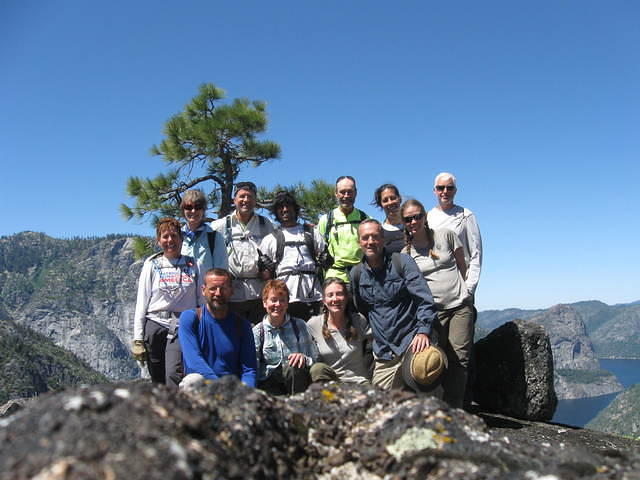
The award-winning WV Yosemite volunteers, June 2013. Photo by Dean Twehues
We just completed the 6th project in the Rancheria Falls area, in the Hetch Hetchy section of the Park. Our work includes removing and ecologically restoring inappropriate campsites, as well as removing non-native invasive species such as salsify, mullein and bull thistle from the Tiltill meadow, a remote high sierra valley with an abundance of wetlands and wildlife. The project requires volunteers to backpack in approximately 6.5 miles to base camp and an additional daily 6 mile roundtrip hike to get to the work site. Sadly, the Hetch Hetchy area is still being impacted by the massive Rim Fire, so we're sure our volunteer stewardship work will be greatly needed in the coming years.

Photo of Hetch Hetchy taken on the WV service project in Yosemite, June 2013 by Lawrence Herko

Dave Pacheco and Paul Goldberg of the WV staff will be on hand in Yosemite to accept the award. The award ceremony will be held on National Public Lands Day - Saturday, September 28th at 4pm in front of the Valley Visitor Center, and will be followed by a raffle and live music as part of the Park's 5-day Yosemite Facelift event. You are welcome to come celebrate with us! The 10th annual Yosemite Facelift is an effort to help clean-up the Park at the end of the busy summer season and runs from September 24 - 29.

Volunteers working in Yosemite, June 2013. Photo by George Ralston

See more photos from this project and more via the WV photo gallery.

Tuesday, August 13, 2013

Last Opportunities to Give Back with WV in 2013


Last week, we crossed the halfway mark for our 16th season of giving something back through weeklong service projects.  While there's still a large amount of work to be done, there aren't many spots available in the latter half of our season.  However, spaces are still available for these three neat places:

Mt. Rainier National Park, Sept. 8 - 14
Often referred to simply as "the mountain" by locals, Mt. Rainier is the most prominent topographical mountain in the contiguous United States. At 14,411' the massive stratovolcano can be seen from as far away as Portland, OR and Victoria, BC. Just under 60 miles from Seattle, the mountain and surrounding area offer tons of wilderness land to explore. Our service project in this very popular National Park is lending much needed restoration support to the Park Service. We will assist the restoration crew by transplanting native plant seedlings in subalpine meadows near the toe of Emmons Glacier. We will be car and tent camping down the road at White River Campground for the week, a developed site with amenities that is often noted for having breathtaking scenery. This is an active service trip appropriate for newcomers to backcountry volunteering and does not involve backpacking. Join us on the mountain in September.

San Gabriel Mountains Proposed Wilderness, Sept. 29 - Oct. 5

The San Gabriel Mountains are more than a scenic backdrop for the bustling city life of LA and the inland empire. These mountains support an interesting array of wildlife, many native species of plants benefiting from the range of microclimate and elevation variation, and also provide a much needed watershed for Southern California. Our service project in this proposed wilderness  is the removal of invasive Spanish Broom, which thrived following 2009's wildfires. We'll work with the Angeles National Forest's biology team to eradicate these invasives and also collect native seed for replanting.  Join us on the first WV project in the San Gabriels.


Big Bend National Park is unique as the largest protected area of Chihuahuan desert in the United States with more than 120,000 species of plants within its boundary. Lying on the Mexico border, the area offers an exceptional range of biodiversity with elevations ranging from 1,800' to more than 7,800'. The area offers much in the way of human history with archaeologists uncovering items dating back more than 9,000 years! Our service project will focus on trail maintenance and erosion controls on several key passages throughout the Park.  We'll stay in an established Park Service campground in the center of the Park, offering a great base to explore.  Learn more and join us on the last WV project of 2013, in Big Bend.


Wednesday, May 01, 2013

Wednesday, April 03, 2013

Our National Parks - An Infographic Story

Friends over at the MPA program at the University of North Carolina - Chapel Hill put together this neat infographic on Our National Parks:

Our National Parks: The Pride of America [Infographic]
MPA@UNCOnlineMPADegrees.com

Saturday, February 26, 2011

The Sounds of Nature

Rocky Mountain Nat'l Park, CO (2008)

This week's New York Times has an interesting article describing the National Park Service's efforts to restore natural sounds and minimize intrusive noise in California's Muir Woods National Monument. Whether the whir of automobiles, the roar of construction crews, or the hum of campground generators, such commotion can disturb not only visitor experiences but also wildlife, with potentially serious consequences.

And as this article makes resoundingly clear, there's a lot that can be done to cut down on this intrusive noise pollution and preserve the acoustics and sounds of these national treasures.

Get the full story here and check out the National Park Service's audio gallery of natural sounds.

Tuesday, October 05, 2010

Measuring Old-Growth, Using Your Inseam

Selway Bitterroot Wilderness, ID (2010)

Open any outdoor magazine and you can find countless gadgets and gizmos that will make your backpacking trip more pleasant. The options range from the simple and obvious - Leatherman, headlamp, Duct Tape - to the advanced and luxurious - GPS, solar powered battery chargers, ultraviolet water purifiers - to the downright strange and unusual - think thermoelectric galoshes and wearable windmills. (Yes, these things do exist.)

Yet despite the onslaught and advances of modern technology, backcountry resourcefulness and ingenuity is not dead. Not even close. Anyone who's ever "used leaves" can attest to that. (As can anyone who's ever been hiking above treeline, without a pack, in a burn zone, heard nature's call, and turned to his Leatherman and T-shirt for salvation. Sleeveless anyone?)

In some cases, our ingenuity has even been helped along by this very technological progress. (Ever taken a picture on your digital camera of a serious backcountry injury and given it to someone who's headed for help?) Still, there exists a strong - and contentious - argument that our survival skills have been hampered by the very technology designed to make our lives easier and safer. (See these New York Times and Slate articles for point and counterpoint in that debate.)

Regardless of where you stand on that issue, it is indisputable that one of the great joys of backpacking is the unique opportunity it provides people of all backgrounds and experience levels to exercise creativity and resourcefulness in their efforts to be self-reliant and solve problems - no matter how big or small.

And with that, here's one volunteer's creative approach to problem-solving on WV's Mount Rainier National Park service trip. Read about it here.

Have any tips or creative tales of your own to share? Share them here.

Friday, March 19, 2010

Nesting Sea Turtle Rehab, Hawaiian Style

I just returned from the Hawaiian Volcanoes National Park service project where we backpacked 8 miles losing 2700-feet to get to a remote beach at Halape where we set up camp for a week of making the beach a more friendly place for rare hawksbill turtles, a critically endangered sea turtle, to nest. We started the hike in a mist, hiking through rainbows over a lava flow from the 1970s, and descending to a beautiful sunny oasis on the southeast side of the Big Island of Hawaii.As this sign below describes, these sea turtles are very rare and face continuing threats. One threat not listed on the sign is the invasive plants taking over the beaches making it hard for the mother turtles to reach a safe sandy place to make a nest, and all but impossible for the tiny hatchling turtles to negotiate on their way to the ocean. The prime offender is haole koa, leucaena leucocephala which grows in large thickets over beach sand making it difficult not only for the sea turtles, but for everyone visiting the beaches. We spent the days sawing, lopping and pulling these trees, clearing the forward beach areas along Halape and Halape-iki. We also removed an invasive passiflora vine and many large rocks from these beach areas just above the high tide line where the turtles look for nesting spots.Camping on the beach was wonderful, with the incredible ocean vistas, the views up and down the coast line, the nearby swimming lagoon and a brackish water plunge in a nearby crack for washing off at the end of the day. One afternoon we hiked to the nearby Keahou Beach where there is a more protected lagoon and spent several hours snorkeling amid the brightly colored corals and fishes.
The picture above shows our group posed under a carved coconut trunk (there were many standing sentinels along the campsite trail). Michal, Ashely, Igor, Randy and Lee joined me for this wonderful experience under the volcano. We will all have dreams of the baby turtles growing strong and being able to make it to the ocean this summer and fall due to our efforts.Mahalo to the Park Service for their organization and support, and their continuing efforts to protect these special places!

Wednesday, November 25, 2009

America's Wild Spaces

Denali National Park, AK (2007)

If you're looking for something to do this Thanksgiving, and watching the Cowboys annual Thanksgiving football game doesn't fit the bill, check out National Geographic's new series titled "Americas Wild Spaces."

The series takes an in-depth look at Yellowstone National Park (all 2 million acres of it, which makes it bigger than Rhode Island and Delaware combined), Death Valley (from its highest peak at 11,049 feet to its lowest point 282 feet below sea level), the Grand Canyon (which, yes, can be seen from space), the Appalachian Trail (all 2,175 miles, 165,000 white blazes, and 5 million steps), the Everglades (and its 1000 species of plants, 300 species of birds, and 27 species of snakes - 4 of them venomous), Yosemite National Park (home to Yosemite Falls, which is 13 times taller than Niagara, and giant sequoias that are wider than most city streets), Hawaii's Papahanaumokuakea Marine National Monument (try saying that ten times fast!), Canyonlands National Park (and its thousand year old rock art and petroglyphs), and Denali (home to North America's tallest mountain - which is still growing!).

The Thanksgiving day marathon begins at 2pm on the National Geographic Channel. Check the schedule here.

Interested in visiting any of these places? Check out the WV 2010 project list, which features projects in many of these locations. Spring projects have been posted, and Summer/Fall projects will be announced on December 4th.

Happy Thanksgiving...and Happy Trails!

Tuesday, September 08, 2009

America's Best Idea...

Ken Burns Speaking at Rutgers University, May 2009

This past May, I had the pleasure of listening to documentary filmmaker Ken Burns. A brilliant speaker, Burns was presented with the Stephen E. Ambrose Oral History Award by the Rutgers Living History Society, and spoke to a full house of veterans and family members who have shared their stories with the Society's Oral History Archives and were being inducted into the Society's Hall of Fame (my 90 year-old grandfather, a WWII veteran and POW, among them). Testifying to the power of oral histories in his acclaimed Civil War and World War II documentaries, Burns expressed his dislike for top-down historical narratives that describe events from the viewpoints of only the famous and great - i.e. the generals and the presidents - preferring instead to offer viewers "a bottom-up appreciation of the ordinary private."

Burns, who has been making documentary films for over 30 years and is regarded as one of the most influential documentary makers of all time, spoke with impressive command and precision about his start in documentary film, the drama and life that exist in old photographs, "the Ken Burns effect," the link between baseball and American society, and the upcoming debut of his new series, "The National Parks: America's Best Idea," which will begin airing on PBS on September 27th. This six-part, twelve-hour history is, in his own words:

"The story of the ideas and individuals that made this uniquely American thing happen...that is to say, for the first time in human history land was set aside not for kings or noblemen but for everyone and for all time. We invented it - it's now been copied by everyone else - and writer and historian Wallace Stegner said, 'It's the best idea we've ever had."

Grand Canyon National Park, AZ est. 1919

(Click here for a video of his comments.)

Keeping with Burns's signature approach, "America's Best Idea" is told from the bottom-up - oral history style - by ordinary folks from all backgrounds - rich and poor, black and white, yellow and brown, educated and illiterate - who were influential in creating today's National Park system. (Teddy Roosevelt, often regarded as the father of the park system, gets only a brief mention in only one episode.) Burns's tale is a biography of American character and American landscape, and is sure to be a visual feast and a spectacular lesson in American history.


Rocky Mountain National Park, CO est. 1915

Piqued your interest? Mark your calendars for September 27th and watch the previews here.

Enjoy!

(Interested in getting a closer, more personal look at the series before the September 27th debut? Check out the calendar of events for information about promotions in your area.)


Thursday, August 06, 2009

Hidden Gems

Check out the Huffington Post for a quick look at "The Top Ten Best National Parks You Don't Know About." Learn about a new place and vote for your favorite.

WV runs trips in four of the parks listed: Acadia, Olympic, Glacier, and Haleakala.

What's missing from this list? And what are "The Top Ten Best National Forests & Wilderness Areas You Don't Know About?"

I'd put Idaho's Sawtooth Wilderness and Virginia's Washington & Jefferson National Forest (complete with its herds of "wild" ponies) near the top. How 'bout you?