
Wilderness Volunteers hosted our first service project with Joshua Tree National Park last month and we were able to help their trail crew finish a needed project refinishing the cholla cactus garden trail and making it more accessible to visitors.
Volunteer Tom Coroneos documented his experience on his 18th WV project and created this lovely video. Take a look and hopefully you can join us next year when WV returns to Joshua Tree NP in 2016.
Joshua Tree Wilderness Volunteers 2015 from Tom Coroneos on Vimeo.
The full 2016 schedule will be released in early December. Spring projects are available right now on the WV website.
Showing posts with label trail work. Show all posts
Showing posts with label trail work. Show all posts
Monday, November 16, 2015


Wednesday, June 17, 2015
Truly Wild - Nevada's Jarbidge Wilderness
 |
| A photo from WV's 2011 project in the Jarbidge Wilderness |
 |
| Jarbidge boasts many different plant species and lots of wild flowers |
 |
| A previous WV basecamp in the Jarbidge |
 |
| Join WV as we give back in the beautiful Jarbidge Wilderness |
Tuesday, April 29, 2014
Cool Adventures Towering Above Hot Moab
Join Wilderness Volunteers on our second annual project in the La Sal Mountains of the Manti-La Sal National Forest, July 27 - August 2, 2014. The La Sal Mountains are the second highest range in Utah and offer miles of trails, great wildlife viewing, abundant fields of wildflowers, comfortable temperatures and astounding views of the slick-rock deserts below.
Our service project for 2014 is conducting maintenance of heavily used trails in the Geyser Pass area of the central La Sal range. The Manti-La Sal National Forest struggles to keep a myriad of user types all satisfied and trails delineated for specific purposes. We'll improve drainage and increase the stability of the trail tread. We'll set up a car camp around 10,000' elevation for the week, and day hike to the work sites with tools. Nearby peaks top out in the range of 12,000', so come prepared for some free day hiking with unbelievable views...and don't forget your camera!
Read more about the area in our interview with Brian Murdock - Recreation, Wilderness & Trails Manager for the Monticello/Moab ranger district of the Manti-La Sal National Forest.
 |
| Photo from the La Sal Mountains out to the Red Rock Desert, Taken July 2013 by P. Goldberg |
 |
| La Sal Mountains loom behind Fisher Towers - July 2013, photo by P. Goldberg |
Wednesday, January 15, 2014
Interview with Brian Murdock of the Manti-La Sal National Forest
We recently caught up with Brian Murdock, the Recreation, Wilderness & Trails Manager for the Monticello/Moab ranger district of the Manti-La Sal National Forest to talk about our work in the Dark Canyon Wilderness; our next project there is May 11 - 14, 2014.

"The area that I am fortunate to manage is the Dark Canyon Wilderness. I have heard it referred to as the wild heart of the Colorado Plateau and I like that description. I believe one of its most unique qualities is the solitude it offers. As more and more of our wildlands are seeing increasing use, the logistics of getting into the area and the sheer remoteness of the canyon makes use relatively low in the Dark Canyon area. If you want a real wilderness experiences with a good chance of being completely alone and you are prepared, this is the place.
We are always in need of trail work. The wilderness is a dynamic system and keeping trails open and passable is a Herculean task that never ends. Wilderness Volunteers has put a lot of time into helping the US Forest Service remove tamarisk which we finished up in 2013.
Currently the recreation and wilderness staff on our district consists of two full time employees and 5-7 seasonal employees. The reality of our work is that we cannot meet all of the demands we have in managing developed and dispersed recreation, trails (non-motorized and motorized), outfitter and guides, and our winter recreation program on two different mountain ranges (the LA Sals and the Abajo/Elk Ridge) with the staff we have. Volunteers are a necessity if we want to fulfill our management responsibilities and Wilderness Volunteers has been one of our best partners in achieving our wilderness management goals.

Our most recent projects with Wilderness Volunteers has included two annual trips each year for the past 8 years. In the spring we have conducted tamarisk inventories and removal and in the fall we do cultural inventories of the area. In 2013 we cleared the final tamarisk from the wilderness (that we know about). It was very satisfying to be able to clear all of the springs and wetlands of the invasive trees. I am sure there are still some lurking out there but Wilderness Volunteers made the Dark Canyon Wilderness a much more natural and wild place with the work they did removing tamarisk. We also conducted a trail project this year in the La Sal mountains with Wilderness Volunteers that was very successful. The enthusiasm of the volunteers is always infectious. I love introducing people to new areas and watching them fall in love with Dark Canyon and the other areas we manage.


You can continue to give back when not on a WV project by educating everyone around you about the importance of public lands and in particular about wilderness. I think a lot of the American public have major misconceptions about wilderness. Having Wilderness Volunteers telling others about their volunteer trips and their accomplishments can go a long way in educating the public about wilderness and its management."
Wednesday, November 20, 2013
Interview with Annette Smits, North Zone Trails Coordinator for the Gila National Forest
We checked in with Annette Smits, the North Zone Trails Coordinator for the Gila National Forest ahead of our returning service project there, June 8 - 14, 2014. We asked Annette about the area, her work and how to help, among a number of other topics.
Tell us about the most unique aspect of the wilderness area that you manage. What draws visitors here?
 In my zone (I cover 3 districts of the Gila) we cover 2 wilderness areas-all of the Blue Range and the western half of the Gila Wilderness, as well as General Forest Areas (GFA) and Inventoried Roadless Areas (IRA).
For the Blue Range the most unique feature is likely solitude, I can think of few other areas that give the user a chance to truly get away from it all. We have amazing dark skies, great hunting, and opportunities to catch glimpses of wildlife of all sorts from elk to raccoons or hear wolves howling in the distance.
For the Gila, the biggest draw is that it is one of the original wilderness areas, where Aldo Leopold got some of his inspiration. Where the green fire died in the wolf’s eyes. The western half has extremely rugged terrain that draws people looking for a challenge.

We partner with WV, because we need help. What makes WV such an ideal group to work with is the continuity of leadership, the ease of working with leaders who are already savvy about being out in the woods and leaving no trace, and the general professionalism of Wilderness Volunteers as an organization.

Being our eyes and ears out in the field. I cover about 1½ million acres in my zone, so needless to say there are a lot of things that I don’t know about as far as day to day stuff. Though we may or may not be able to deal
 with the issue rapidly, the sort of things that are very helpful for us to know about are:
Tell us about the most unique aspect of the wilderness area that you manage. What draws visitors here?

For the Blue Range the most unique feature is likely solitude, I can think of few other areas that give the user a chance to truly get away from it all. We have amazing dark skies, great hunting, and opportunities to catch glimpses of wildlife of all sorts from elk to raccoons or hear wolves howling in the distance.
For the Gila, the biggest draw is that it is one of the original wilderness areas, where Aldo Leopold got some of his inspiration. Where the green fire died in the wolf’s eyes. The western half has extremely rugged terrain that draws people looking for a challenge.
Tell us about the most important types of projects a group of volunteers can do to help in your wild backcountry areas.

Trail work. In my opinion trails bring people into our great public lands and give them the opportunity to experience them and grow to love them. Trail work is hard work in that is very demanding in terms of resources. Trails serve as a means to concentrate use, and reduce impact to natural resources (for example we typically route our trails away from sensitive resources whether cultural or biological). I think if we provide a sound way for people to come out and enjoy our backcountry they will start to love them and want to protect them.
Why do you work with Wilderness Volunteers?
We partner with WV, because we need help. What makes WV such an ideal group to work with is the continuity of leadership, the ease of working with leaders who are already savvy about being out in the woods and leaving no trace, and the general professionalism of Wilderness Volunteers as an organization.
About the WV service project:

Our projects have been on the Continental Divide Trail (CDT) construction. Currently much of our route of the CDT is on roadways, where non-motorized users are competing for space with trucks and ATVs. For the last few years we have been working on creating a new trail where people can enjoy the panoramic vistas, in the peace and quiet that the Gila is known for. In the still of the forest a user can catch glimpses of herds of elk, bobcats, deer, bears, various birds, coyotes, and other wildlife. It may be a personal bias here, but these things can make for an outstanding trip whether out for the day or on a longer trip. In partnering with WV we are giving more people the chance for these experiences. The way in which WV operates make them an extremely easy group to work with. There is always going to be set up time with any project, but due to good planning and working with the same leadership every time the amount of work that goes into a WV trip is much less than what is generally expected with volunteer groups in general. Working with WV, all that I really need to do is show up with tools, safety equipment, and water the rest of the in and out day-to-day logistical stuff is covered by WV. Any trip that is being coordinated by WV is one that as I can count on as being a productive week as a land manager, and an enjoyable week on a personal level.
How can folks continue to give back to your area when not on a WV project?
Being our eyes and ears out in the field. I cover about 1½ million acres in my zone, so needless to say there are a lot of things that I don’t know about as far as day to day stuff. Though we may or may not be able to deal

· Water and spring conditions (or lack thereof)- this is the most common question I get asked, and being in the southwest water is almost always scarce. If at least I could say as an example- as of June 18th there was water in spring x. At least it’s a bit more certain than a guess.
· Noxious weeds- this is starting to become more of an issue in our areas. If we have the opportunity to find and remove these outcropping while they are still small we have a much better chance of removing them.
· Trail conditions- not necessarily a single tree down, but if there are excessive numbers of them down, trail has extreme washouts, if the trail is very difficult to find, or anything that looks out of the ordinary out there.
Thursday, September 12, 2013
WV Honored as Yosemite Volunteer Group of the Year
Wilderness Volunteers has been selected as the Volunteer Group of the Year by Yosemite National Park!
With over 9,500 volunteers donating their time and energy in Yosemite this year, it is a great honor to be chosen as the best of the year. We're grateful for the hard work of all of our volunteer participants and especially the project's leaders, Dean and Laurie Twehues. Victoria Hartman, Yosemite's Wilderness Restoration Coordinator, recognizes the group by saying, "Your work is critical to the park’s ability to protect and preserve our rich natural and cultural heritage while providing meaningful and enjoyable experiences for our visitors." All participants will be receiving a thank you gift from the Park as part of the award.
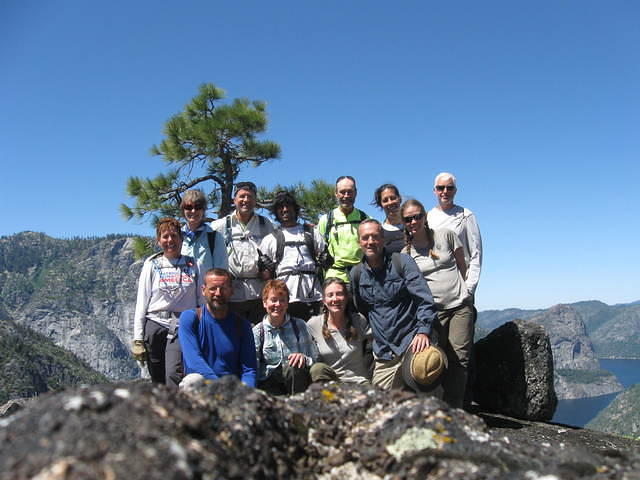 |
| The award-winning WV Yosemite volunteers, June 2013. Photo by Dean Twehues |
 |
| Photo of Hetch Hetchy taken on the WV service project in Yosemite, June 2013 by Lawrence Herko |
Dave Pacheco and Paul Goldberg of the WV staff will be on hand in Yosemite to accept the award. The award ceremony will be held on National Public Lands Day - Saturday, September 28th at 4pm in front of the Valley Visitor Center, and will be followed by a raffle and live music as part of the Park's 5-day Yosemite Facelift event. You are welcome to come celebrate with us! The 10th annual Yosemite Facelift is an effort to help clean-up the Park at the end of the busy summer season and runs from September 24 - 29.
 |
| Volunteers working in Yosemite, June 2013. Photo by George Ralston |
See more photos from this project and more via the WV photo gallery.
Wednesday, August 14, 2013
Report From The Field: Sawtooth National Recreation Area
Report From The Field by Dave Pacheco

Under the long-time supervision of Liese Dean, Wilderness Program Coordinator, and Deb Peters, Assistant Trails Supervisor and expert packer, we backpacked in five miles to a campsite in the Stanley Creek area of the wilderness and immediately got familiar with our home for the week. Our first impressions were how incredibly clean the water flowed through this magnificent granite-based, Lodgepole pine forest -- some of the clearest water we had ever seen. And we couldn't help but be starkly reminded that the entire location, camp and work sites, were in a burned area from a 2007 fire.
For the next five days we made daily forays of up to eight miles round trip performing an assortment of

Over the course of the week, we were thrilled with late night visits through camp by Mule deer and elk, and on the smaller scale we were entertained by pika, Clark's nutcracker, bluebird, and some very colorful Western tanagers. Thankfully, Thursday's storms that touched off wildfires across Idaho were well away from the immediate area, but they did make for some incredible evening red skies. The Sawtooth NRA is a place of many streams, deep glacial lakes, craggy peaks, and it's a place many of us will return to as we constantly explore wild America. If you're looking for a spectacular wilderness adventure, join us next year for another week in the Sawtooths!
Tuesday, August 13, 2013
Last Opportunities to Give Back with WV in 2013
Last week, we crossed the halfway mark for our 16th season of giving something back through weeklong service projects. While there's still a large amount of work to be done, there aren't many spots available in the latter half of our season. However, spaces are still available for these three neat places:
 Mt. Rainier National Park, Sept. 8 - 14
San Gabriel Mountains Proposed Wilderness, Sept. 29 - Oct. 5
 The San Gabriel Mountains are more than a scenic backdrop for the bustling city life of LA and the inland empire. These mountains support an interesting array of wildlife, many native species of plants benefiting from the range of microclimate and elevation variation, and also provide a much needed watershed for Southern California. Our service project in this proposed wilderness is the removal of invasive Spanish Broom, which thrived following 2009's wildfires. We'll work with the Angeles National Forest's biology team to eradicate these invasives and also collect native seed for replanting. Join us on the first WV project in the San Gabriels.
Big Bend National Park is unique as the largest protected area of Chihuahuan desert in the United States with more than 120,000 species of plants within its boundary. Lying on the Mexico border, the area offers an exceptional range of biodiversity with elevations ranging from 1,800' to more than 7,800'. The area offers much in the way of human history with archaeologists uncovering items dating back more than 9,000 years! Our service project will focus on trail maintenance and erosion controls on several key passages throughout the Park. We'll stay in an established Park Service campground in the center of the Park, offering a great base to explore. Learn more and join us on the last WV project of 2013, in Big Bend.
Wednesday, July 03, 2013
Praise from the Colorado National Monument
"...developing a relationship with Wilderness Volunteers has really paid off."
We received the following kind letter from S. Conrad Clements, Trails Work Leader for the Colorado National Monument. We're extremely grateful for all the hard work our agencies put in protecting this special wild land and other unique areas just like it. We've had several successful service projects at the CNM and look forward to returning next year. You can see many photos of our most recent project within the Colorado National Monument at our gallery.
We received the following kind letter from S. Conrad Clements, Trails Work Leader for the Colorado National Monument. We're extremely grateful for all the hard work our agencies put in protecting this special wild land and other unique areas just like it. We've had several successful service projects at the CNM and look forward to returning next year. You can see many photos of our most recent project within the Colorado National Monument at our gallery.
Tuesday, May 07, 2013
WV Partners In the News - HawkWatch Intl and the Goshute Mountains
Check out this neat article in the May/June issue of Nevada Magazine about one of our partners, HawkWatch International. WV's upcoming project June 2 - 8 in the Goshute Mountains is a combined project, as we'll work to maintain the trail used to access this important HawkWatch site.
Monday, May 06, 2013
My First WV Project
While I’ve come to get the know Wilderness Volunteers very well over the last half year as the organization’s first Development Coordinator, it wasn’t until the recent service project in America's newest national park, Pinnacles, that I got to experience WV in the field. It was a truly wonderful experience getting out into the wild to give something back as well as meeting a terrific group of dedicated volunteers and park personnel.
We arrived to the Pinnacles campground on the east side of Pinnacles on a warm Sunday afternoon after a lovely drive down highway 25, known as Airline Highway supposedly because pilots used the highway as a marker on the route from LA to San Francisco. The highway has beautiful rolling hills as it parallels the San Andreas Fault, which figures into how Pinnacles came to be. The exposed rocks of Pinnacles' peaks differ from these surrounding foothills, as it is part of the remains of a massive ancient volcano that was active 23 million years ago. As part of the Pacific Ring of Fire, the volcano was 15 miles long and nearly 8,000 feet high. Surprisingly, the volcano was located nearly 200 miles to the southeast, just north of where LA is today. Due to the earth's tectonic plates colliding and shifting, the volcano was split and two-thirds of the remains have been pushed north to where it lies now. As the plates moved, the mass sank and erosion has carved the impressive spires that are the Park's most recognizable feature. Surprisingly, the rocks continue to move towards San Francisco at the rate of a quarter of an inch per year.


 The California Condor was very nearly extinct due to poaching, lead poisoning and habitat destruction - with only a population of 22 in the wild in the 80s. A controversial captive breeding program began in 1987 by the government and continues to this day. Pinnacles is an important site for monitoring the health of the population, with other important sites in Southern California, Baja and Arizona. Those original 22 birds were given numbers #1-22 and tagged with monitors. The population has now reached more than 400, with more than 200 living in the wild.
 |
| The WV group at Machete Ridge in Pinnacles NP |
 |
| Hard to believe these rocks made a 200 mile journey to get here. |
After we all arrived and set up camp, the group began to get to know each other over our first fabulous meal prepared by Carleton Sheppard. Wonderful meals would become a regular occurrence during our week at Pinnacles thanks to Carleton. The other half of our leader team, Bill Sheppard, then gave us a brief intro on what to expect for our first workday the following morning, when we would meet with the NPS staff.
 |
| On the hunt for thistle, Photo by Ulrich Boegli |
After a hearty breakfast, we were introduced to the park by NPS staff Brent, Lucy and Esperanza, who gave a great overview of the Park's features, history, conservation management goals and potential hazards to be aware of during our time in the backcountry. We were then given leather work gloves, counters, hiking poles and snake chaps as we set out to begin our week hunting for invasive plants throughout the park. Lucy and Esperanza would be our guides for the week and we began by searching from the Bear Gulch area back to campground for invasive Italian Thistle. We scoured hillsides and walked along a wide seasonal creek bed filled with native poppies. After lunch we spread out to scour through a section of forest until one of our volunteers, John, found the mother load of thistle. We all joined together in an approx. 40' x 40' area to pull thousands of this invasive weed that has been choking out native species.
Tuesday was our free day, since there was a meeting that required attention from NPS staff and we split into groups to climb into the heart of the park via the High Peaks Trail, sadly leaving behind one of our compatriots at camp who was feeling under the weather. Despite leaving at different times and taking slightly different routes, our group met up at the Scouts Peak lookout that offered views to the west of the Salinas Valley and the Santa Lucia Mountains that lie run along the coast. We then climbed the steep and narrow section of the trail, which was exhilarating! Yet another fabulous lunch was followed by nice views of the Balconies section of the park and then venturing down Condor Gulch trail, which gave terrific views of the rocky crags and spires. Tuesday also was the first time for confirmed sightings of one of the park's other claims to fame - home to the endangered California Condor.


Wednesday morning was the coldest of the week, reaching just above freezing. While the cool nights
generally offered a nice respite to the hot and dry 90 degree days, this was a very chilly morning. We warmed ourselves by a nice morning fire before taking off on one of the longer hikes of our time in the park. Departing from the Old Pinnacles trailhead, we walked north of the high peaks we had climbed the day before, along the relatively level Chalone Creek - named after the indigenous people who lived in the area. All week long we saw many beautiful birds and butterflies, and this day was no exception. After reaching the entrance for the West side of the park, we went off-trail to attack the other invasive plant we would hunt during our time at Pinnacles - invasive mustard. We found many mustard plants, some right as they were flowering, preventing the plants from reaching the bolting stage. All the while, we had terrific views of Machete Ridge. After successfully removing several thousand mustard plants, we trekked back to the eastside of the park, passing through Balconies Cave. The caves in Pinnacles are another fun feature of the Park. They are above-ground Talus caves, formed by falling boulders and rocks trapped in steep canyons. The caves are partially closed to protect the bat populations that make their home there and are fully closed to the public during breeding season.
 |
| There's invasive mustard under there. |
Thursday was a fascinating day as we were introduced to Alacia Welch, one of the Park's Condor Biologists. Alacia led us to areas of the Park normally closed to the public. We ventured up a steep road to a ridge where we would continue our hunt for invasive plants. Working along steep terrain, we were treated to views that few visitors to Pinnacles see. We also watched a young condor perch in a tree nearby the NPS facility and then watched as it took flight over our heads. Their wingspan is seriously impressive. We asked Alacia every question we could think of, and weren't able to stump her. We toured the condor facility and saw how they trap and release birds, and monitor the birds through one-way mirrors.
 |
| Alacia answered every question we could think of. |

We also assisted Alacia by moving brush to cover exposed water lines that had recently been installed by the facility. We then continued to hunt for invasive plants and took an adventurous off-trail route down the mountain and back to the campsite.
 |
| Our group covered the line behind this way neat condor facility |
Friday was our last work day, but it proved to have some of the most impressive scenery of our time at Pinnacles. We began by traveling through the Bear Gulch caves and reaching the bear Gulch Reservoir - a man-made reservoir to be used in case of fire protection. We then ventured off-trail into backcountry canyons, searching for more invasive plants, finding both thistle and mustard, as well as hundreds of butterflies, birds and a snake or two.


My first WV service project was an absolute blast. By my estimates we pulled more than 10,000 invasive plants, covered over 30 miles of hiking and saw a terrific array of flora and fauna. My biggest takeaway, however, was how wonderful all the participants were! Our leaders, Bill and Carleton, were fantastic and kept us safe and well fed. All the volunteers were lovely folks, had a wonderful attitude and really embodied the spirit of giving something back. I can't wait for my next WV trip!
Thursday, April 11, 2013
Great Places to Give Something Back
Our 16th season of giving something back is now underway and there are still available spots on service projects in some seriously great wild places:
Alta Toquima Wilderness, June 23-29

This amazing central Nevada wilderness area lies in the middle of the Toquima Mountain range as part of the Humboldt-Toyaibe National Forest (largest NF in the lower 48). Offering excellent hiking and majestic sweeping views, the area offers amazing Great Basin recreation. Our service project will be general trail maintenance in lush Pine Creek Canyon and camping in an established campsite. Learn more and join WV at Alta Toquima.

While the Mallard-Larkins Pioneer Area lacks formal wilderness designation, it does NOT lack for wild beauty. The area's 30,00 acres are part of a larger section of 260,000 roadless acres in north central Idaho that features rugged landscape, many fantastic lakes and impressive biodiversity. The service project will focus on general trail maintenance from an established campsite that offers striking panoramic views. Join us in Mallard-Larkins.
 Sawtooth National Recreation Area, Aug. 4-10
 Central Idaho's Sawtooth National Recreation Area and surrounding White Cloud Mountains have a breadth of terrific recreational opportunities, including top-notch hiking, biking and fishing. You'll fall in love with the area's natural beauty and the wide-range of flora and fauna that the area supports. Our service project is a backpacking trip in lush and narrow Little Casino Creek Canyon, where we'll be doing trail maintenance to keep this trail open and passable. Learn more about the WV project in the Sawtooth NRA

Jedediah Smith Wilderness, Aug. 25-31

Travelers comes from around the world to reach the storied and sometimes crowded parks of Yellowstone and Grand Tetons and experience the Greater Yellowstone Ecosystem. On the west side of the Teton range, stretching across the Wyoming and Idaho border lies the lush forests and gradual rise of the Jedediah Smith Wilderness, offering outstanding biodiversity without the crowds. We'll backpack in several miles and work on the Hominy Peak trail, rerouting and building erosion controls to keep it accessible. Join us in the spectacular Jedidiah Smith Wilderness.

While many deserts are lively ecosystems, few can match the wide range of flora and fauna of southern Arizona's Saguaro National Park. Boasting more than 900 species of plants, over 200 species of birds and countless other biological fascinations, this globally unique ecosystem is an area not to be missed. Our project is in the Rincon Mountain Wilderness, that rise high above the Sonoran desert and offer changing temperatures. We'll camp by our vehicles at the base of the mountains and hike up the Rincons working on trail maintenance of the Miller Creek trail. Learn more and join us in Saguaro National Park.
The San Gabriel Mountains are more than a scenic backdrop for the bustling city life of LA and the inland empire. These mountains support an interesting array of wildlife, many native species of plants benefiting from the range of microclimate and elevation variation, and also provide a much needed watershed for Southern California. Our service project in this proposed wilderness is the removal of invasive Spanish Broom, which thrived following 2009's wildfires. We'll work with the Angeles National Forest's biology team to eradicate these invasives and also collect native seed for replanting. Join us on the first WV project in the San Gabriels.
Big Bend National Park is unique as the largest protected area of Chihuahuan desert in the United States with more than 120,000 species of plants within its boundary. Lying on the Mexico border, the area offers an exceptional range of biodiversity with elevations ranging from 1,800' to more than 7,800'. The area offers much in the way of human history with archaeologists uncovering items dating back more than 9,000 years! Our service project will focus on trail maintenance and erosion controls on several key passages throughout the Park. We'll stay in an established Park Service campground in the center of the Park, offering a great base to explore. Learn more and join us on the last WV project of 2013, in Big Bend.
Wednesday, February 27, 2013
Project Spotlight: Weminuche Wilderness, San Juan National Forest
 |
| Signs of a WV project, Weminuche 2012, photo by Eric Hill |
Our project will focus on a section of the Continental Divide Trail north of Wolf Creek Pass in the San Juan Mountains. We will work to ensure the trail is passable with general trail maintenance and proper erosion controls. Our base camp will be at 11,400' after a several mile backpack, affording a great launching point for the work as well as free time adventures.WV project leader Jeff Moorehead had the following to say about the project:
 |
Talk about the Spur-Throated Grasshopper
with Jeff, photo by diverdewan15
|
I love WV trips because everyone attending shares a love for wild places and hard work. Hard work in a wild place brings out the best in a personality and so a WV trip can be a very human experience as well. I endeavor to keep everyone well-fed with good tasting dishes and that is one luxury afforded by the pack train support. Many of my dishes were trail tested on the Pacific Crest Trail which I hiked in 2006. After dinner, I like to discuss hot-bed environmental issues or anything really. In general, I love science discussions. I am an evolutionary biologist that especially loves the world of insects-- specifically grasshoppers and other assorted acridids. People attending the Weminuche trip can expect to hear about the prolific endemic speciation of the alpine Melanoplinae grasshoppers. I'm not sure I buy the current explanation. If that doesn't get people excited, I've been known to sneak up my Martin backpacking guitar and entertain them with songs that are usually set at much lower elevations.
 |
| WV participants take a break for a look around on a free day in the Weminuche Wilderness, WV 2012, photo by Eric Hill |
 |
North American Divides by pfly
|
There are many large hydrological divides in the world (the line that separates neighboring drainage basins). None, however, can match that grandeur and prominence of the Continental Divide of the Americas or simply the Great Divide. Determining whether water flows into the Atlantic of Pacific Ocean, the Great Divide stretches from northern Alaska down to southern Patagonia, mostly following the highest peaks of the impressive ranges of the Rockies and the Andes.
 |
| The scenic San Juan Mountains in the Weminuche Wilderness, WV 2012, photo by Eric Hill |
Subscribe to:
Posts (Atom)


